Thomas Bangalter: Daft Punk Career, Music, Net Worth and Lasting Legacy
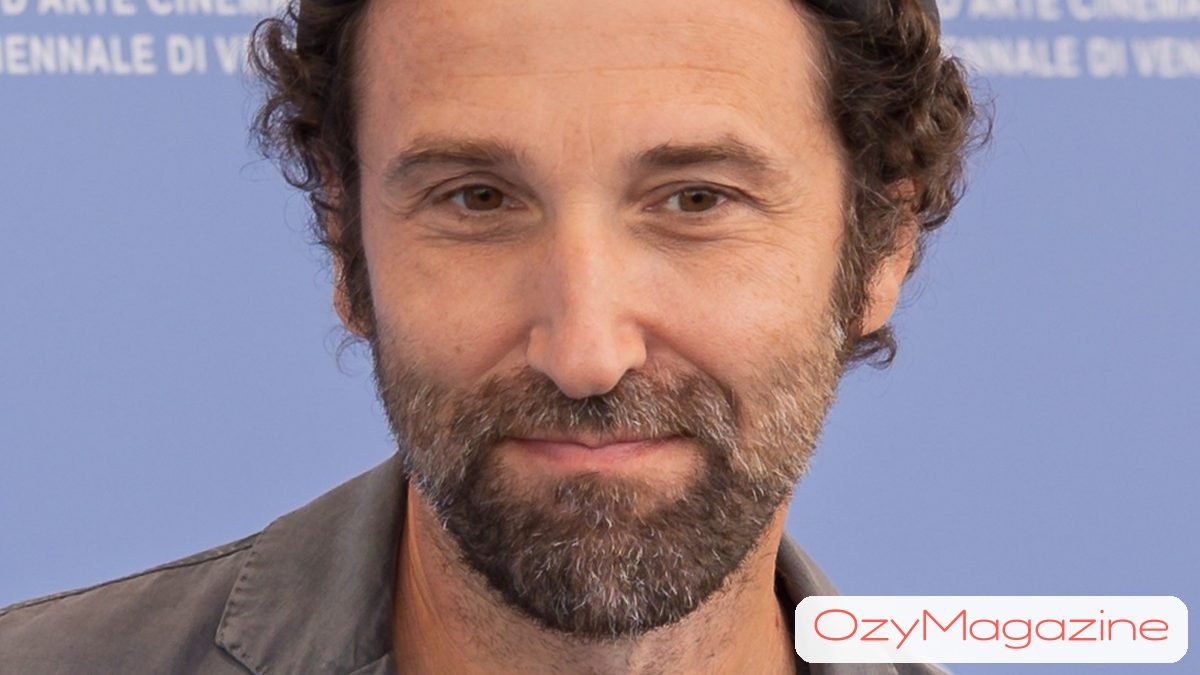
Thomas Bangalter is the French musician, producer and composer who spent 28 years hidden inside the silver half of Daft Punk’s robot helmets. Born in Paris on January 3, 1975, he helped turn French house music into a global language.
His story runs from a bedroom studio in Paris to the biggest stages in electronic music. Alongside Guy-Manuel de Homem-Christo, he built a catalogue that moved from raw club tracks to Grammy-winning albums recorded with live musicians.
Since Daft Punk ended in 2021, he has stepped out from behind the helmet. He now writes for ballet companies, film directors and fashion houses, and he appears in public as himself rather than as a robot.
Quick Answer
Thomas Bangalter, born January 3, 1975, in Paris, is a French musician and composer, best known as the silver-helmeted half of Daft Punk. Since the duo split in 2021 he has scored ballets including Mythologies and Mirage.
Who Is Thomas Bankalter?
The name is often mistyped as Thomas Bankalter, but the correct spelling is Thomas Bangalter. He is a musician, record producer, DJ and composer from Paris, France, and one of the most influential figures in electronic music history.
For most listeners he is first and foremost a member of Daft Punk. The duo he formed with Guy-Manuel de Homem-Christo in 1993 released four studio albums and reshaped how electronic music sounded, looked and performed live.
Beyond the duo, he founded the Roulé record label, recorded the evergreen club single “Music Sounds Better with You” as Stardust, and composed film scores. His solo work has accelerated since 2021.
Thomas Bangalter: Quick Facts
| Information | Details |
|---|---|
| Full name | Thomas Bangalter |
| Common misspelling | Thomas Bankalter |
| Date of birth | January 3, 1975 |
| Birthplace | Paris, France |
| Nationality | French |
| Age | 51 years old (2026) |
| Profession | Musician, composer, DJ, record producer |
| Famous for | Daft Punk |
| Musical genres | Electronic, house, French house, disco, classical |
| Former musical partner | Guy-Manuel de Homem-Christo |
| Record label | Roulé |
| Notable projects | Daft Punk, Stardust, Mythologies, Mirage |
Thomas Bangalter at a Glance
Some careers are defined by a single group, however wide that group’s shadow falls. Our recent profile of ann fleischer told the opposite kind of story, about a life lived almost entirely outside the spotlight her husband occupied.
More verified music and film profiles appear across our Celebrity coverage, where the documented record matters more than the rumour mill. Bangalter’s entry in that record is unusually complete, because the work itself was always public even when the man was not.
- Born January 3, 1975, in Paris, and trained at the piano from the age of six
- Co-founded Daft Punk with Guy-Manuel de Homem-Christo in 1993
- Founder of the Roulé label and the Stardust one-off single in 1998
- Winner, with Daft Punk, of six Grammy Awards including Album of the Year
- Composer of the ballet scores Mythologies and Mirage since the 2021 split
Thomas Bangalter’s Early Life and Family Background
Thomas Bangalter was born on January 3, 1975, in Paris. He started piano at six years old, taking lessons from a member of the Paris Opera’s music staff, and his parents insisted the practice never slipped.
He has said he thanked them later for that strictness. The discipline of daily classical practice sat underneath everything he later did with drum machines, samplers and, eventually, a full orchestra.
Music was the family trade, even if he resisted copying it. His mother, Thérèse Thoreux, was a classical dancer and choreographer, and the household treated performance as ordinary work rather than glamour.
How His Family Influenced His Career
His father, Daniel Bangalter, worked professionally as Daniel Vangarde, a songwriter and producer behind acts such as the Gibson Brothers, Ottawan and Sheila B. Devotion. The young Thomas watched hit records being built from the inside.
Bangalter has said he never intended simply to follow his father. Even so, Vangarde’s industry knowledge proved valuable when Daft Punk began negotiating the record business, and he was thanked in the liner notes of Homework.
That background helps explain the duo’s unusual independence. Bangalter understood contracts, publishing and ownership early, and Daft Punk kept a degree of control that most young electronic acts never had.
How Thomas Bangalter Met Guy-Manuel de Homem-Christo
Bangalter met Guy-Manuel de Homem-Christo in 1987, when both attended the Lycée Carnot secondary school in Paris. They bonded over shared tastes in films and in the music of the 1960s and 1970s.
With Laurent Brancowitz they formed an indie rock trio called Darlin’, in which Bangalter played bass guitar. A Melody Maker review dismissed their sound as “a daft punky thrash”, and the insult outlived the band.
When the pair’s interest shifted towards electronic music, Brancowitz left to join Phoenix. The two friends kept the reviewer’s phrase, shortened it, and carried it into an entirely different genre.
The Formation of Daft Punk in 1993
Daft Punk took shape in 1993, when Bangalter played a demo of their material to Stuart Macmillan of the Scottish duo Slam. The tape led to a first single, “The New Wave”, released the following year.
The pair were still teenagers when the project began, working with modest equipment in Bangalter’s bedroom. That room would soon become one of the most famous home studios in dance music.
From the start they treated the act as a complete world, not just a recording name. The songs, the imagery and later the robots were all designed to belong to one fictional universe.
What Made Daft Punk Different?
French house in the mid-1990s was largely a club culture, but Daft Punk wrote tracks with the hooks and structures of pop songs. Their loops were built to be remembered, not only to be mixed.
They also hid behind a concept. First came masks, then the full robot characters, which let two shy Parisians become larger than any ordinary stage persona.
Finally, they worked slowly and kept control. Four studio albums across two decades meant every release arrived as an event rather than as product.
Homework (1997): Daft Punk’s Breakthrough Album
Homework, released in January 1997, was recorded largely in Bangalter’s bedroom; he later joked that he had to move the bed into another room to make space for the equipment.
The album took the energy of Chicago house and Detroit techno and filtered it through French pop instincts. It announced a new centre of gravity for dance music in Paris.
Its influence spread quickly through clubs and charts alike. For many listeners outside France, Homework was the record that proved electronic albums could be as distinctive as rock albums.
Famous Songs From Homework
- “Da Funk”, the squelching instrumental that became the duo’s first signature track
- “Around the World”, built on a single repeated phrase and a Michel Gondry video
- “Revolution 909”, a wry nod to the dancefloor politics of the era
- “Burnin'”, a filtered house workout named in tribute to Chicago producers
- “Alive”, the closing track that foreshadowed their later live reputation
Why Homework Was Important
Homework proved that a dance act could record a coherent, personal album at home and sell it worldwide. That lesson shaped a generation of bedroom producers who followed.
It also established the duo’s working method. Samples were treated as raw material for new compositions, and repetition was used as a deliberate, hypnotic tool rather than a shortcut.
Discovery (2001): The Album That Transformed Daft Punk
Discovery arrived in 2001 and turned Daft Punk from club favourites into pop figures. Where Homework was raw, Discovery was polished, melodic and openly nostalgic for the disco and soft rock of their childhoods.
The album embraced samples from 1970s and 1980s records and rebuilt them into bright, emotional songs. It remains the duo’s most beloved record for many listeners.
It was also the moment the robot helmets became permanent. The duo later framed the change with a playful story about an accident in the studio on September 9, 1999.
Most Popular Songs From Discovery
- “One More Time”, the euphoric opener sung by Romanthony that topped charts across Europe
- “Aerodynamic”, which pairs a funk sample with an arpeggiated guitar solo
- “Digital Love”, a tender track built around a Supertramp-era sample
- “Harder, Better, Faster, Stronger”, later famous again through a hit hip hop sample
- “Something About Us”, the album’s slow and romantic closing mood
The Emotional Side of Electronic Music
Discovery argued that machine music could carry longing, joy and melancholy at full strength. Its songs are simple on the surface and carefully sentimental underneath.
Bangalter’s classical childhood is audible in that balance. The chord changes behave like pop standards, even when the sounds around them are synthetic.
Discovery and Interstella 5555
The album later became the soundtrack to Interstella 5555, a 2003 animated film created with manga legend Leiji Matsumoto. The film tells its story entirely through the album’s songs, with no dialogue.
The project underlined how visual the duo’s thinking had become. Discovery was not only a record but the score to an imagined film that eventually got made.
Why Did Daft Punk Wear Robot Helmets?
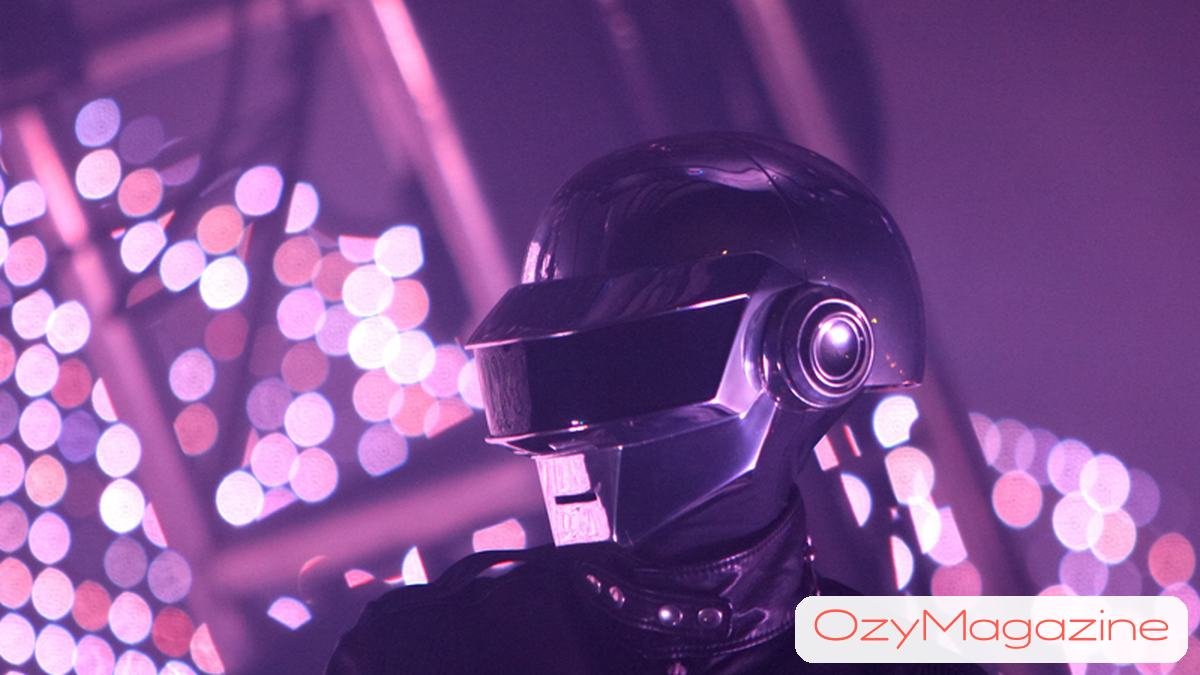
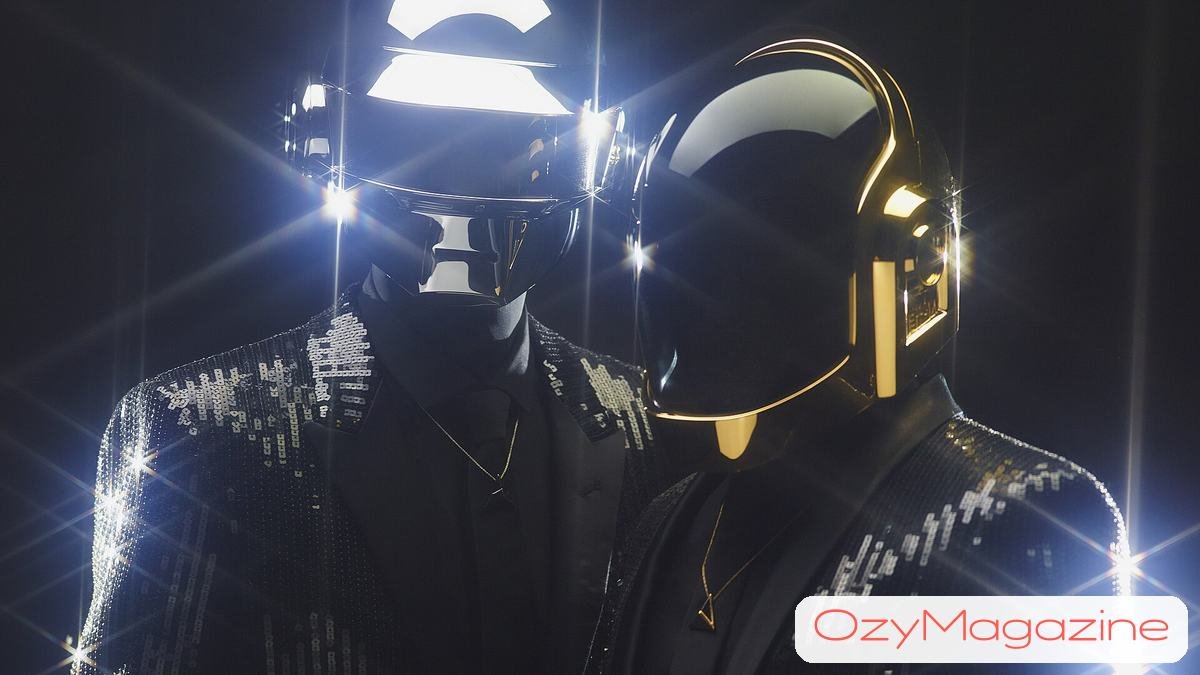
The helmets arrived with the Discovery era, when the duo replaced earlier masks with two fully realised robot characters. Bangalter wore the silver helmet; Guy-Manuel de Homem-Christo wore the gold one.
They rarely explained the choice in plain terms, preferring jokes about waking up as robots after a studio accident. The effect, whatever the intention, was to make the characters famous and keep the men private.
For over twenty years the helmets did their work. Daft Punk could sell out arenas while both members walked through airports unrecognised.
The Meaning Behind the Robot Identity
Bangalter has described the robot as a way of exploring the line between humans and machines. The characters let the music ask that question visually every time the duo appeared.
There was also a practical philosophy behind it. The duo wanted audiences to project themselves onto the music rather than onto two personalities, and the blank helmets made that easy.
How the Helmets Strengthened Their Brand
Few images in music are as recognisable as the two helmets side by side. They worked as a logo, a stage costume and a promise of anonymity all at once.
The helmets also future-proofed the act. Robots do not age, give embarrassing interviews or age out of their own mythology, so the brand stayed intact across decades.
Human After All (2005): Exploring Technology and Repetition
Human After All, released in 2005, was recorded in a matter of weeks and stripped the duo’s sound back to something rawer and more repetitive. Critics at the time were divided.
Tracks such as “Robot Rock” and “Technologic” reduced songs to single riffs and phrases, pushed until they became hypnotic. It was the opposite of Discovery’s lush warmth.
Time has been kind to the record. Its stark loops anticipated the harder electronic sounds that dominated festivals in the following decade.
Why Human After All Matters
The album’s title stated the duo’s theme outright: beneath the machinery, the work was about being human. Its repetition feels less like automation than like obsession.
It also set up their greatest live triumph. The Alive tour would fuse this material with the first two albums and reveal how well it all fitted together.
Alive 2007: Reinventing Electronic Live Performance
The Alive tour of 2006 and 2007 placed the duo inside a giant illuminated pyramid and rebuilt their catalogue as a continuous live remix. The Paris concert of June 2007 became the album Alive 2007.
Songs were layered over one another until the whole back catalogue behaved like a single instrument. Audiences who had treated Daft Punk as a studio act left converted.
The album won the Grammy Award for Best Electronic/Dance Album, and its recording of “Harder, Better, Faster, Stronger” won Best Dance Recording at the same ceremony season.
What Made Alive 2007 Special?
Most live electronic shows of the era meant two people behind laptops. Alive instead looked and sounded like a rock spectacle, with the pyramid’s lights choreographed to the music.
It also proved the catalogue’s depth. Tracks from three albums combined so naturally that the show played like a greatest-hits set from a band with twice the output.
Random Access Memories (2013): Daft Punk’s Greatest Commercial Triumph
After years of silence, Random Access Memories arrived in 2013 as a deliberate tribute to the album era. The duo recorded with live session musicians, vintage equipment and a roster of heroes and contemporaries.
Giorgio Moroder, Nile Rodgers, Pharrell Williams, Paul Williams and Julian Casablancas all appear. The record rejected the laptop methods the duo had helped popularise and chased the feel of 1970s studio craft.
It became their biggest commercial success and won Album of the Year at the Grammy Awards, an almost unheard-of honour for an electronic act.
Get Lucky: A Global Hit
“Get Lucky”, with Pharrell Williams singing over Nile Rodgers’ guitar, was the sound of the summer of 2013. It reached number one in dozens of countries and won Record of the Year at the Grammys.
The song’s warmth came from its method: real musicians playing together in a room, then edited with the duo’s usual precision.
Other Important Tracks
“Lose Yourself to Dance” reunited the team with Pharrell for a slower, sweatier groove. “Instant Crush”, sung by Julian Casablancas, gave the album its melancholy centre.
“Touch”, featuring Paul Williams, stretched into an eight-minute suite that summarised the album’s themes of memory and longing. “Giorgio by Moroder” opened with the disco pioneer’s spoken life story.
Grammy Awards and Recognition
At the 2014 Grammy Awards the album collected Album of the Year and Best Dance/Electronica Album, while “Get Lucky” took Record of the Year and Best Pop Duo/Group Performance.
Added to the two awards from the Alive 2007 era, Daft Punk finished with six Grammy Awards. In France, both members had already been made Chevaliers of the Ordre des Arts et des Lettres in 2010.
Thomas Bangalter’s Solo Career
Bangalter’s solo career ran in parallel with Daft Punk from the beginning. His vinyl-only EPs Trax on da Rocks, released in 1995 and 1998, showed a rougher, more playful side of his production.
He also recorded with DJ Falcon as Together, releasing the singles “Together” in 2000 and “So Much Love to Give” in 2002. Both became staples of the French house scene he helped create.
Since 2021 the solo career has become the main career, conducted partly through his label Alberts & Gothmaan, an anagram of his own name.
The Roulé Record Label
Bangalter founded Roulé, French for “rolled”, in 1995 as an outlet for his own tracks and for producers he admired. It released music by Romanthony and Roy Davis Jr. alongside his solo singles.
The label’s catalogue is a compact history of French house in the 1990s. Its records were built for clubs but written with the same melodic care as his album work.
Roulé was wound up in 2018, closing a chapter that had run alongside the whole Daft Punk story.
Why Roulé Was Important
Roulé showed that Bangalter’s influence was never only about his own releases. The label gave other producers a platform and helped define the filtered French house sound.
It also demonstrated his independence. Long before streaming, he owned a route to release music entirely on his own terms.
Stardust and Music Sounds Better With You
In 1998 Bangalter teamed up with Alan Braxe and Benjamin Diamond as Stardust. Their single “Music Sounds Better with You”, built around a sample from Chaka Khan’s “Fate”, became a worldwide club hit.
The record reached number two in the United Kingdom and filled dancefloors for years. It remains one of the defining singles of French house.
Remarkably, it was the group’s only release. Stardust never recorded a follow-up, which turned the single into a self-contained legend.
What Made the Song Special?
The track loops a few seconds of disco into something that feels like pure lift. Diamond’s wistful vocal floats over the loop without ever resolving into a conventional chorus.
Its economy is the lesson: one sample, one voice, one feeling, sustained for six minutes. Producers still study how little it needs to work.
Why Stardust Did Not Release an Album
The three members each had other commitments, and the single’s success arrived faster than any plan for more. Rather than dilute it, they let the one record stand.
A remastered edition appeared in 2019 for the song’s twentieth anniversary, with Braxe and Diamond confirming the trio had returned to the studio to prepare it.
Thomas Bangalter’s Film Soundtracks
Bangalter’s screen work began as a solo composer and grew into some of Daft Punk’s most visible projects. Film let him write at lengths and moods that club records never allowed.
His scores favour texture and dread as often as melody. Directors who want electronic music with genuine menace tend to reach for his name.
Irréversible (2002)
His first full score accompanied Gaspar Noé’s Irréversible in 2002, a film notorious for its extremity. Bangalter’s music uses low frequencies and relentless pulses to keep the audience on edge.
The soundtrack album also placed his tracks beside Mahler and Beethoven. It announced that his ambitions reached well beyond the dancefloor.
Tron: Legacy (2010)
Daft Punk’s score for Tron: Legacy fused their electronics with a full orchestra, matching the film’s world of programs and light cycles. It became one of the most praised film scores of its decade.
The music was a natural meeting of subject and composer: a film about humans inside machines, scored by two men who performed as robots.
Other Film Collaborations
Bangalter served as sound effects director on Noé’s Enter the Void in 2009 and contributed the track “Sangria” to Climax in 2018. He scored Quentin Dupieux’s Daaaaaalí!, released in 2024.
He has also stepped in front of the camera, taking an acting role in Cédric Jimenez’s Chien 51, which premiered at the Venice Film Festival in 2025.
Why Did Daft Punk Break Up in 2021?
On February 22, 2021, Daft Punk posted an eight-minute video called “Epilogue”, drawn from their 2006 film Electroma. In it, one robot self-destructs while the other walks away into the desert.
No detailed explanation followed, and none has really come since. After 28 years, four albums and a complete conquest of their genre, the duo simply closed the story on their own terms.
The two remain friends and still share a studio and equipment. The split ended the group, not the partnership’s goodwill or either man’s career.
Did Thomas Bangalter Retire From Music?
No. Bangalter made clear within a few years that Daft Punk was finished but he was not, saying he had no intention of abandoning electronic instruments for good.
His calendar since proves the point: ballet scores, film work, production for other artists and, in October 2025, a surprise set at the Centre Pompidou in Paris, reported as his first public DJ performance since 2009.
Health had shaped that absence. He has spoken about a tinnitus scare in 2002 that pushed him away from club DJing for years, before he later recovered enough to return occasionally.
Mythologies (2023): Thomas Bangalter’s Classical Music Transformation
Mythologies began as a ballet, choreographed by Angelin Preljocaj and premiered in Bordeaux in July 2022. Bangalter’s 90-minute orchestral score was then released as his first solo album in April 2023, on the Erato label.
The album contains no electronics at all. Written for a full orchestra, it explores the founding myths of ballet itself across a series of short, vivid movements.
Promoting it, Bangalter appeared in interviews without the helmet for the first time in his career. He told the New York Times that, much as he loved the character, the last thing he wanted to be in 2023 was a robot.
What Is Mythologies About?
The score revisits archetypes from classical mythology and dance history, treating them as short character studies rather than as one continuous symphony. Romain Dumas conducted the recording.
It is deliberately approachable orchestral writing. Bangalter wanted listeners who knew him only for house music to be able to follow every theme.
Why Mythologies Was a Major Career Milestone
Mythologies was the first major work he had ever signed purely as a composer, with no duo, no alias and no helmet. Critics who had pigeonholed him as a producer had to reassess.
It also completed a circle that began with piano lessons at age six. The classical training his parents insisted on finally became the headline rather than the footnote.
Chiroptera and Bangalter’s Contemporary Dance Projects
In November 2023 Bangalter worked with the artist JR and choreographer Damien Jalet on Chiroptera, a vast open-air performance staged in front of the Paris Opera. More than 150 dancers performed inside a cavernous structure built for the event.
His soundtrack for the project was released in 2024, alongside hours of raw session material. A related short film, An Urban Allegory, followed with the same collaborators.
Dance has become his second stage. He also contributed to En Corps in 2022 and composed for Apaches, a ballet by Saïdo Lehlouh that premiered in 2024.
Mirage (2026): A Return to Experimental Electronic Composition
Mirage grew out of another collaboration with Damien Jalet, a ballet for sixteen dancers first staged in 2024. Bangalter released the music as a solo album in June 2026.
Where Mythologies set electronics aside entirely, Mirage brings his synthesizers back into the theatre. It is the clearest sign yet that his post-Daft Punk career moves in both directions at once.
What Makes Mirage Different?
The score was written for bodies in motion rather than for clubs or concert halls, so its structures stretch and breathe differently. Long electronic textures replace the tidy loops of his house records.
Working on Mirage also led him to compose for the fashion house Anrealage, whose Paris shows in 2025 and 2026 carried his music down the runway.
Why Mirage Matters
Mirage answers the question fans asked after Mythologies: whether the orchestral turn meant leaving electronic music behind. It did not.
Taken together, the two ballet albums describe his current position precisely — a composer equally at home with an orchestra, a synthesizer and a stage full of dancers.
Thomas Bangalter’s Music Production Techniques
Bangalter’s production style was formed in a bedroom and refined in the world’s best studios. Certain habits run through everything he has made, from Homework to the ballet scores.
1. Creative Sampling
He treats samples as instruments rather than decorations. A two-second disco fragment becomes the harmonic and rhythmic engine of an entire track, as “Music Sounds Better with You” proved in 1998.
2. Filter Automation
The sweeping filter is the signature gesture of French house, and Bangalter was one of its architects. Slowly opening a filter over a loop creates the sense of a song rising out of water.
3. Repetition and Groove
His tracks trust repetition completely. A riff is stated, held and varied only slightly, until the smallest change feels enormous — the method behind both “Da Funk” and Human After All.
4. Combining Human and Electronic Sounds
Random Access Memories pushed this furthest, placing live drummers, bassists and guitarists inside meticulously edited arrangements. The ballet scores apply the same thinking to an orchestra.
5. Minimalism and Musical Arrangement
One of his most useful lessons is that arrangement matters more than accumulation. His best records use very few elements, each given space to be heard clearly.
Thomas Bangalter’s Personal Life
Bangalter is married to the French actress Élodie Bouchez. The couple have two sons, Tara-Jay, born in 2002, and Roxan, born in 2008, and they live in Paris after a period based in Beverly Hills.
His instinct for privacy long predates the helmet. It is the same protective streak visible in our profiles of gina martin wilson and dianne holechek, two women who spent decades beside famous men while keeping their own lives firmly their own.
In recent interviews he has reflected on the anonymity itself, saying it eventually attracted more attention than it removed. Since 2023 he has generally appeared as himself, bearded and unmasked.
Thomas Bangalter’s Net Worth
Many readers search for Thomas Bangalter’s net worth because of Daft Punk’s international success. No audited figure exists, and Bangalter has never publicly confirmed one.
Celebrity Net Worth estimates his fortune at $90 million, while other trackers place him somewhere between $70 million and $100 million. These are editorial estimates built from public signals, not disclosures.
The income behind the estimates is easier to document: album sales and royalties across three decades, the Alive tours, film scores, production work for artists such as The Weeknd and Arcade Fire, and a catalogue that keeps licensing worldwide. Presenting any single number as established fact would go beyond the evidence.
Thomas Bangalter’s Awards and Achievements
With Daft Punk, Bangalter collected honours across three decades, from club culture’s underground awards to the highest prizes in the recording industry. France decorated both members of the duo in 2010.
His production work for others also reached the top of the charts. Daft Punk’s collaboration with The Weeknd, “Starboy”, became the duo’s first number one single on the Billboard Hot 100 in 2016.
Major Career Achievements
- Six Grammy Awards with Daft Punk, including Album of the Year for Random Access Memories
- Record of the Year for “Get Lucky” at the 2014 Grammy Awards
- Chevalier of the Ordre des Arts et des Lettres, awarded by France in 2010
- Co-writer and producer of “Starboy”, a Billboard Hot 100 number one in 2016
- Composer of the Tron: Legacy score, one of the most acclaimed electronic film scores
- First solo album, Mythologies, released by the classical label Erato in 2023
How Thomas Bangalter Influenced Modern Electronic Music
It is hard to find a corner of modern dance music that Bangalter did not touch. His influence runs through production technique, live performance and the visual language of electronic acts.
Making Electronic Music Mainstream
Daft Punk’s albums carried club music into homes, cars and award shows without sanding down its edges. Discovery in particular taught pop audiences to hear samples and loops as songwriting.
Changing Expectations for Live Shows
The Alive pyramid reset what a dance act’s concert could be. The festival-scale spectacles that followed, from headline DJ productions to full visual worlds, all descend from that staging.
Connecting Music With Visual Identity
The robots demonstrated that an electronic act could have an image as strong as any rock band’s. Anonymous and masked performers across genres have followed the template ever since.
Encouraging Artistic Reinvention
His own career is the argument: house producer, film composer, orchestral writer, then back to electronics for the theatre. Few artists of his commercial stature have changed lanes so completely, so late.
Practical Lessons Musicians Can Learn From Thomas Bangalter
His career doubles as a practical education for younger producers: how a sound gets built, when a direction deserves changing, and how an artist stays in charge of the work. The lessons are easy to list and hard to live by.
Develop a Recognizable Sound
Bangalter’s records are identifiable within seconds, whether the tool is a filtered loop or an orchestra. A signature comes from repeating your own decisions until they become a language.
Experiment With Different Genres
He moved between rock, house, disco, film music and ballet without treating any of them as a betrayal. Each detour sent new ideas back into the main work.
Prioritize Musical Ideas Over Equipment
Homework was made in a bedroom with modest gear, and its ideas outperformed studios full of expensive equipment. The concept, he has often implied, is the instrument.
Build Meaningful Collaborations
From Romanthony to Nile Rodgers to Damien Jalet, his collaborators are chosen for what they uniquely carry. The partnerships recur across decades because they are built on genuine exchange.
Protect Creative Independence
Owning his label, keeping control of the duo’s work and walking away at the peak all served the same principle. Independence is what made the experiments affordable.
Best Thomas Bangalter Songs and Albums to Explore
New listeners can enter his catalogue through the duo’s landmarks and then follow the solo thread. The essential stops below cover every era of his career.
| Song or Album | Project | Why You Should Listen |
|---|---|---|
| Da Funk | Daft Punk | Early electronic experimentation |
| Around the World | Daft Punk | Rhythmic repetition and memorable bass |
| Music Sounds Better with You | Stardust | Classic French house production |
| One More Time | Daft Punk | Uplifting electronic dance music |
| Digital Love | Daft Punk | Melodic and emotional electronic pop |
| Harder, Better, Faster, Stronger | Daft Punk | Innovative vocal processing |
| Robot Rock | Daft Punk | Minimalist electronic arrangement |
| Get Lucky | Daft Punk | Funk-inspired live instrumentation |
| Random Access Memories | Daft Punk | Sophisticated studio production |
| Mythologies | Thomas Bangalter | Orchestral composition |
| Mirage | Thomas Bangalter | Experimental electronic ballet music |
Recommended Listening Order
Start with Discovery for the melodies, then Homework for the raw energy that made it possible. Follow with Alive 2007 to hear the catalogue rebuilt live.
Finish with Random Access Memories and the two ballet albums. Heard in that order, the career sounds like one long argument about what machines and musicians can do together.
Frequently Asked Questions About Thomas Bankalter
1. Who is Thomas Bankalter?
Thomas Bankalter is a common misspelling of Thomas Bangalter, the French musician and composer born in Paris on January 3, 1975. He is best known as one half of Daft Punk, alongside Guy-Manuel de Homem-Christo.
2. Why did Thomas Bangalter leave Daft Punk?
He did not leave a continuing band; the duo ended Daft Punk together in February 2021 with the “Epilogue” video. Neither member has given a detailed reason, and both have remained active separately since.
3. Is Thomas Bangalter still making music in 2026?
Yes. His post-Daft Punk work includes the ballet scores Mythologies and Mirage, the Chiroptera performance soundtrack, film music and production for other artists, and he returned to public DJ sets in 2025.
4. What is Thomas Bangalter’s most famous song?
By reach, “Get Lucky” is the biggest single attached to his name, a worldwide number one and Record of the Year. “One More Time” and “Music Sounds Better with You” run it close in club history.
5. What is Thomas Bangalter’s net worth?
His exact net worth is not publicly verified. Celebrity Net Worth estimates $90 million, and other trackers suggest a range between $70 million and $100 million, but none of these figures comes from Bangalter or from audited records.
When was Thomas Bangalter born?
He was born on January 3, 1975, in Paris, France. The date is carried by his Wikidata record with references to the German National Library authority file and other catalogues, and it matches his English Wikipedia biography.
Is Thomas Bangalter married?
Yes. He is married to the French actress Élodie Bouchez, and the couple have two sons, Tara-Jay and Roxan. The family lives in Paris, and Bangalter has kept their private life largely out of the press.
Conclusion: Thomas Bangalter’s Enduring Influence on Music
Thomas Bangalter’s career describes an arc almost no other electronic musician has matched: from a Paris bedroom to the defining dance albums of two decades, then on to orchestras and ballet stages.
The helmets made him anonymous; the work made him unmistakable. Whether the instrument is a sampler or a string section, the decisions underneath remain recognisably his.
Final Thoughts on Thomas Bangalter
What lingers about Bangalter is the consistency of the curiosity. The boy who practised piano under parental supervision became the producer who hid inside a robot, then the composer who took the robot off to conduct orchestras.
For the full story of the partnership that made his name, the albums, the tours and the long public afterlife are documented in the standard Daft Punk biography. His own second act, by every recent sign, is still being written.