

Simon Luckinbill: Lucille Ball’s Grandson and the Art Career He Built Himself
Most people who search simon luckinbill arrive through his family: his mother is Lucie Arnaz, which makes Lucille Ball and Desi Arnaz his grandparents. Yet the life those searches uncover belongs to a working painter whose career unfolded in Palm Springs galleries, far from television.
The verifiable record is compact, and better for it. Two exhibitions in Palm Springs, one long published interview from 2016 in which he set out his philosophy in his own words, and a family history documented more thoroughly than almost any in show business.
This profile keeps the two apart. Exhibitions, interviews and verified family history appear in full; the details no trustworthy source has ever settled — a precise birth date, a marriage, a personal fortune — are labelled unsettled instead of being quietly invented.
Quick Answer
Simon Luckinbill is an American visual artist, the eldest child of Lucie Arnaz and Laurence Luckinbill and a grandson of Lucille Ball and Desi Arnaz. He paints in acrylic and mixed media, exhibited in Palm Springs in 2014 and 2016, and keeps his personal life private.
Simon Luckinbill at a Glance
Pairing a biography with its fixed points is a habit of this series, and the most recent example before this one is our seung chung diane farr profile, which works through the documented record behind that search in the same way.
Simon earns his place in our Celebrity coverage as a working artist whose surname opens doors his paintings still have to walk through. The fixed points of his record, with the unconfirmed entries marked as unconfirmed, are set out below.
Two exhibitions, one long interview and a famous family tree are the whole of his public file. Everything in the table below comes from that file or from his parents’ documented biographies, and nothing in it depends on the biography sites that copy each other.
| Detail | Information |
|---|---|
| Full name | Simon Thomas Luckinbill |
| Born | December 1980 (month and year as reported; exact day never confirmed) |
| Birthplace | Los Angeles, California, United States (as reported by Coachella Valley Weekly) |
| Nationality | American |
| Profession | Visual artist and painter |
| Mother | Lucie Arnaz |
| Father | Laurence Luckinbill |
| Maternal grandmother | Lucille Ball |
| Maternal grandfather | Desi Arnaz |
| Full siblings | Joseph and Katharine Luckinbill |
| Known artistic mediums | Primarily acrylic painting and mixed media |
| Notable exhibition | Flea On A Hot Rock, Gallery 500, 2016 |
Who Is Simon Luckinbill?
Ask who Simon Luckinbill is and the short answer is a painter: an American artist who shows colourful acrylic canvases in California galleries. The longer answer has to reckon with the surname, because few painters begin life as the grandson of two television pioneers.
What defines him professionally, though, is the choice to exhibit rather than perform. Across a decade of adult life in the public record, there are gallery shows and interviews about painting, and no acting credits at all.
The clearest window into how he thinks is the conversation he gave Coachella Valley Weekly in December 2016. Painting, he explained there, is how he expresses himself and tells stories, and the interview remains the foundation of everything reliably written about his art.
Simon Luckinbill: Quick Biography and Personal Details
Read the table above as a map with the blank spaces left visible. Where a detail about Simon rests on documents or coverage, it is stated plainly; where it rests on nothing but repetition between websites, the wording says so.
His birth date shows why the care is needed. Accounts of his mother’s social-media posts describe a 40th birthday marked in December 2020, and HELLO! magazine put his age at 44 in a 2025 family roundup — two independent pointers to December 1980, neither of which names a day.
The precise day of December that biography sites print so confidently has no such support. Nothing in any record, interview or family statement stands behind it; it is a single unsourced assertion that repetition has dressed up as consensus.
| Detail | Status |
|---|---|
| Profession | Visual artist and painter, documented by exhibition coverage since 2014 |
| Known for | Acrylic and mixed-media paintings shown in Palm Springs galleries |
| Birth date | December 1980 as reported; no exact day confirmed by any reliable source |
| Age | 44, as listed by HELLO! magazine in its 2025 family roundup |
| Nationality | American |
| Marital status | Not publicly documented in any reliable source |
| Online presence | An art page, Sy Art Gallery, was listed by Coachella Valley Weekly in 2016 |
Early Life and Childhood
Coachella Valley Weekly’s account places his birth in Los Angeles and his upbringing in New York. He arrived in December 1980, six months after his parents’ wedding on June 22, the first child of two performers at busy points in their careers.
Being raised on the East Coast kept his childhood at a distance from the industry town his grandparents had helped build. His parents worked constantly in entertainment, but home life happened in New York rather than inside the Hollywood system.
Creativity at home was not confined to acting. Music, singing, theatre and storytelling were the family’s working languages, and Simon’s own early studies ranged across drums, percussion, poetry and nutrition before painting claimed him.
Simon Luckinbill’s Parents
Between them, Simon’s parents cover most of twentieth-century American performance: television sitcom royalty on one side of the family, serious stage acting on the other. Lucie Arnaz and Laurence Luckinbill were both established names long before their son was born.
They have also worked as a double act, touring together in stage productions, so Simon grew up watching performance as a shared family trade — rehearsals, travel and openings included — rather than as two separate careers pursued in parallel.
A household run on rehearsals and touring schedules teaches its own lessons: work is prepared, repeated and judged nightly. Simon’s later insistence on original, slowly-made objects reads like the gallery version of that discipline.
Mother: Lucie Arnaz
Lucie Arnaz, born July 17, 1951, is the daughter of Lucille Ball and Desi Arnaz and the elder sister of Desi Arnaz Jr. She grew up inside the industry her parents dominated, then spent decades building a stage and screen career under her own name.
Television viewers first knew her from her mother’s programmes, but the theatre became her home ground: credits range from the first national company of Seesaw in 1974 to Neil Simon’s Lost in Yonkers on Broadway, alongside concert and cabaret work as a singer.
On film she held her own opposite Neil Diamond and Laurence Olivier in The Jazz Singer in 1980, earning a Golden Globe nomination. That year also reshaped her private life: on June 22, 1980 she married Laurence Luckinbill, an earlier marriage to Philip Vandervort having ended in 1976.
Father: Laurence Luckinbill
Laurence Luckinbill, born November 21, 1934, built his reputation in the theatre as actor, playwright and director, frequently all three on the same production. His signature works are one-man plays inhabiting Theodore Roosevelt, Lyndon B. Johnson, Ernest Hemingway and Clarence Darrow.
Broadway gave him his highest honour: a Tony Award nomination for The Shadow Box in 1977. The one-man format suited a performer fascinated by how historical figures argue, persuade and perform themselves in public.
Cinema audiences meet him in two very different places — the landmark 1970 film The Boys in the Band, reprising his stage role, and Star Trek V: The Final Frontier in 1989, where he played Sybok, Spock’s half-brother. His first marriage, to actress Robin Strasser, produced Simon’s half-brothers Nicholas and Benjamin.
Simon Luckinbill’s Famous Grandparents
Curiosity about Simon usually starts one generation up. His mother’s parents did not merely star in early television; they helped invent its grammar, its business model and its afterlife in reruns.
He never saw them work. Both died during his childhood in the 1980s, so the grandparents the world knows reached him through family memory, recordings and an industry still running on their inventions.
There is a strangeness to that inheritance worth naming. His grandparents were, for millions of strangers, familiar weekly presences in their living rooms, while for their grandson they were relatives known mainly through the same screens.
Grandmother: Lucille Ball
Lucille Ball, born in 1911, became the defining face of the American sitcom as Lucy Ricardo in I Love Lucy. The fame can obscure the achievement: she was a precision comic performer whose timing turned domestic chaos into a weekly national ritual.
The programme, first broadcast in 1951, rewired television production. It was filmed with several cameras before a live studio audience, on film rather than live transmission, which meant episodes could be repeated — the rerun, and eventually syndication, began here.
Ball the executive mattered as much as Ball the clown. Running Desilu Productions, she green-lit and owned series that long outlived her own, becoming one of the most powerful figures in the business. She died on April 26, 1989, when her grandson Simon was eight.
Grandfather: Desi Arnaz
Desi Arnaz arrived in American entertainment from Santiago de Cuba, born there in 1917, and conquered it first as a bandleader. His orchestra made him a star of stage and screen before television turned him into Ricky Ricardo, bandleader again, this time fictional.
His lasting contribution sits behind the camera. Arnaz pushed for the multi-camera filming of I Love Lucy before a live audience and for shooting on film stock, decisions that set the technical template sitcoms still follow and created the rerun economy.
Music never left his work; the conga and the orchestra were woven into the Ricardo character and into Desilu’s identity. Desi Arnaz died on December 2, 1986, when Simon was a small child, three years before Lucille Ball.
The Importance of the Arnaz-Ball Legacy
Measured by influence, the Arnaz-Ball inheritance is industrial as much as artistic. The couple changed how comedies were shot, sold and kept alive, and the family name became a byword for television’s founding era.
For Simon, the honest way to hold that inheritance is at arm’s length. It explains the attention paid to him, and nothing about the quality of his painting, which has to be judged in the gallery like anyone else’s.
The legacy is also actively kept. His mother’s generation has spent decades stewarding the Arnaz-Ball story in interviews, productions and family appearances, which is one reason public interest in the third generation, Simon included, has never fully faded.
Simon Luckinbill’s Siblings and Family Relationships
Simon is the eldest of three children born to Lucie and Laurence, and he also has two older half-brothers from his father’s first marriage. The five siblings span two households of the same extended, performance-soaked family.
None of the three younger Luckinbills built a career directly on the family name. Between them they cover music, visual art and legacy work — a spread that suggests a household where creative work was normal but no particular form of it was prescribed.
The pattern extends to privacy as well as profession. All three have kept their personal lives largely out of the press, which is why reliable information about this generation comes in short, verifiable bursts rather than a continuous public record.
Joseph Luckinbill
The middle child, Joseph Luckinbill, chose sound. His documented work sits in music — guitar, songwriting, recording and production — the one sibling career that overlaps with the family’s performing tradition without copying it.
Set the brothers side by side and the contrast is neat: the same upbringing produced a man who works in rhythm and melody and a man who works in pigment and canvas. Each craft has to be judged on output, not ancestry, which is precisely the point.
There is a practical difference too. A musician’s work can be streamed and shared indefinitely, while Simon’s paintings exist as single objects in single rooms — one more reason his public record is thinner than a performer’s would be.
Katharine (Kate) Luckinbill
Katharine, known as Kate, is the youngest of the three. Her documented path runs toward creative and entertainment-related work connected with the family’s own history, rather than toward a public performing career of her own.
Read together, the three siblings map the options open to a famous family’s third generation: make something new, make something adjacent, or help look after what already exists. Simon took the first option, and it is the one this profile documents.
Paternal Half-Brothers
Nicholas and Benjamin Luckinbill are Laurence’s sons by Robin Strasser, and Simon’s elder half-brothers. Their existence makes the household he grew up in a blended one, larger than the trio usually counted in Arnaz family trees.
Like Simon, they have kept their private lives out of public view, and little beyond their place in the family is documented. That place itself is firmly on the record, in both parents’ biographies and in decades of family coverage.
How Simon Luckinbill Discovered His Passion for Art
Nothing about Simon’s route into painting was direct. He spent years sampling other disciplines — music, drumming, poetry, nutrition — before a brush gave him the combination of colour, surface and storytelling he had been looking for.
The 2016 Coachella Valley Weekly interview preserves the moment in his own phrasing: “I found I had a passion for using color, texture and a hint of fantasy to express myself.” The sentence is worth quoting exactly, because everything reliable about his style descends from it.
His childhood had supplied the raw material. A boy raised among performers, musicians and writers was never going to lack for creative vocabulary; painting simply turned out to be the dialect that stayed with him into adulthood.
Simon Luckinbill’s Artistic Style and Painting Techniques
Acrylic on canvas is his stated primary medium, with mixed media as a declared interest. Beyond that, the honest description of his style comes from the 2016 coverage and from what the gallery photographs show: bold colour, worked surfaces, subjects that emerge slowly.
The five elements below are the ones he and his reviewers keep returning to. Together they describe a painter less interested in depicting the world than in staging an encounter with it, which is why his canvases reward the slow look he asks for.
1. The Use of Color
Colour does the expressive heavy lifting in his account of the work. In the 2016 interview he named it first among his tools, ahead of texture and fantasy, and the paintings visible in gallery photographs back the claim up: saturated, high-contrast fields of it.
Vivid colour can signal energy and movement before a viewer has identified a single shape, and calmer passages can slow the eye down. In Simon’s canvases colour is not filling in a drawing; it is carrying the composition itself.
That ordering — feeling first, subject second — is the thread connecting his style to his stated philosophy. If art is only about emotion, then the emotional register has to be set by the first thing a viewer receives, which is colour.
2. Texture and Visual Depth
Surface is his second named tool. A heavily worked canvas changes as a viewer approaches it — ridges, layers and buried marks appear that a flat reproduction cannot show — and that slow reveal is a deliberate part of the experience he offers.
Coverage of his 2016 show made the point concretely with The Hive Mind, a canvas first read as an abstract field of colour that gradually discloses the suggestion of a bamboo grove. The subject is in the texture; miss the surface and the painting stays abstract.
3. Fantasy and Imagination
The third element in his own list is a hint of fantasy, and it functions as permission. A scene can borrow the light of a real landscape while obeying no geography, letting the picture communicate a mood rather than document a place.
Dreamlike imagery also suits a painter who describes his work as storytelling. A recognisable scene tells one story; an invented one lets every viewer find a different story in the same frame.
It is a modest dose by design — a hint, in his word, rather than a full departure into surrealism. The recognisable world stays present underneath, which keeps the fantasy tethered to the nature he lists among his sources.
4. Mixed-Media Experimentation
Alongside straight acrylic painting he has spoken warmly of mixing mediums, with one reservation he was careful to state: “Although there is no substitute for original art, I enjoy mixing mediums. All of the work at this show is original.”
Combining materials — paint with other media laid into the same surface — can add the very texture he prizes, and his comment frames the experimentation as craft rather than novelty: the goal is an original object, not a reproducible effect.
5. Emotional Storytelling
Story is the stated purpose underneath everything else. “I tell stories with my work. After all, art is about emotion. And my art is about me,” he said in the same interview, adding: “Remember art is only about emotion.”
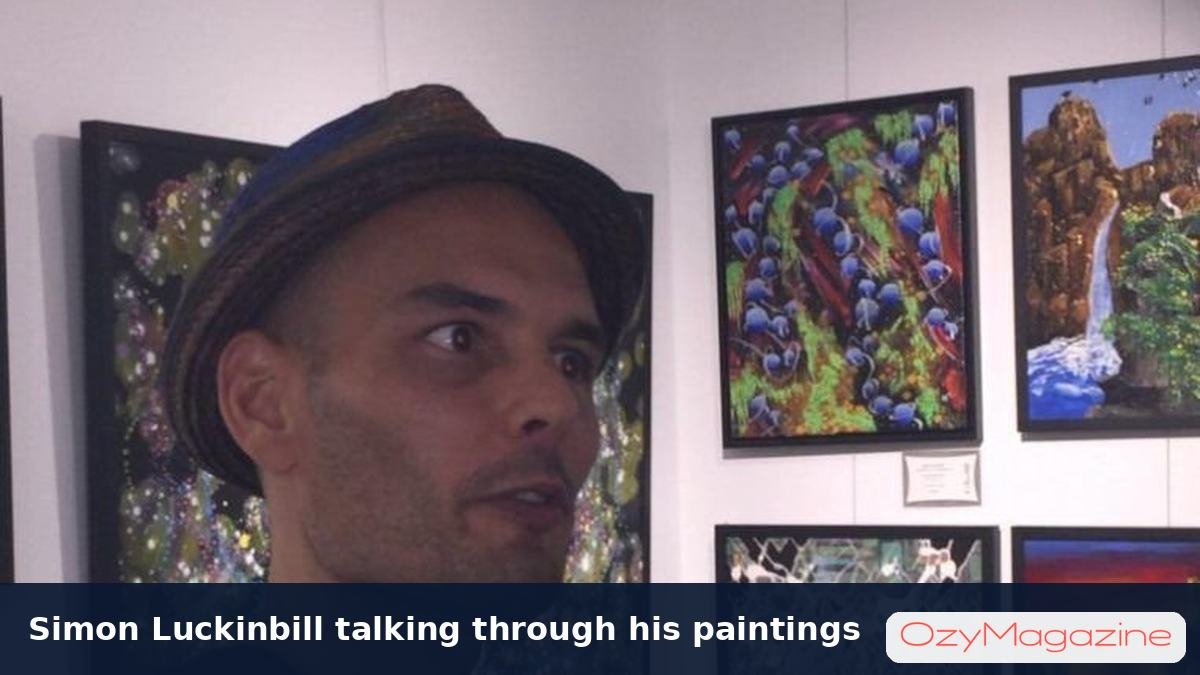
A picture built on that principle starts from the painter’s experience but finishes in the viewer’s, because feelings read into colour and form differ from person to person. His exhibition manner matches the theory: photographs show him talking visitors through the canvases, storytelling in the room as well as on the wall.
What Inspires Simon Luckinbill’s Artwork?
Asked directly, Simon answered with a list rather than a theory: “I draw inspiration from many sources: music, nature, vision quests, and, as a Christian, of course, God.” Then, simply: “These are my source materials.”
The list is worth taking seriously because it is his own. Where the biography sites guess at influences from his style, the interview records him naming them, and the four sources below follow the order in which he named them.
Music
Music is not a metaphor for him; it is former training. Years of drums, percussion and broader musical study sit behind the rhythm people notice in the paintings, where repeated shapes and alternating colours do the work a beat does in a song.
His route ran the other way from his brother’s. Joseph stayed with sound as a profession, while Simon carried the training into a silent medium, where the rhythm has to be supplied by pattern and repetition instead of by a beat.
Nature
Landscapes, plants, animals and shifting light supply the second source. Nature hands a colourist an endless, unrepeatable palette, and hands a texture painter surfaces — bark, water, rock, leaf — that no studio exercise can match.
The desert around Palm Springs, where he exhibits, teaches the lesson in extreme form: flat glare from a distance, dense detail up close. His landscapes borrow that structure even when their colours are invented.
Spirituality and Christian Faith
Faith is the source he flagged with “of course,” and it sits in his answer exactly where he placed it: one wellspring among several, named plainly. “Vision quests” sit beside it in his answer, suggesting reflection and searching rather than doctrine as the operative ideas.
In practice that reads as permission to treat painting as a reflective act. The work is not religious illustration; it is work made by a man who counts his beliefs among the materials he brings to the easel.
It is also consistent with the rest of his answer. Music, nature, vision quests and faith are all things encountered rather than manufactured, which fits a painter whose method depends on looking slowly at what is in front of him.
Personal Experiences
The last source is his own past, and he has described its effect precisely: the work changed as he changed, with early efforts, in his phrase, “an exploration of feelings.” A body of work built that way becomes a diary in paint.
That is also why his paintings resist quick summary. Each canvas records where its maker was at the time, so the collection reads as a sequence of states rather than variations on a single theme.
Simon Luckinbill’s Art Exhibitions and Professional Career
Exhibitions, not interviews, are the proof of a painting career, and Simon has two documented ones, both in Palm Springs and both covered while they happened. They are modest in number and solid in the only way that matters: verifiable.
Palm Springs is also family ground. His parents settled there, and the desert art scene gave him a professional context close to home but separate from the entertainment industry his family is known for.
First Art Exhibition: Archangel Gallery, 2014
His public debut came in Palm Springs in March 2014, when Archangel Gallery showed his paintings and writer Sue Cameron covered the opening. The date matters: some later accounts move the evening to 2016, but the contemporary report is from 2014.
Cameron’s account recorded the detail that made the evening news: more than half the paintings sold within roughly ninety minutes of the doors opening. For a first exhibition, that is the kind of commercial reception artists hope for and rarely get.
Opening-night sales are a beginning, not a bank statement. They establish demand on one evening in one gallery; they say nothing reliable about lifetime earnings, a distinction that matters when his finances come up below.
Gallery 500 Exhibition: Flea On A Hot Rock, 2016
His second documented show, Flea On A Hot Rock, opened at Gallery 500 in The Five Hundred building in December 2016 — his second exhibition in the Coachella Valley — and ran through the end of that month.
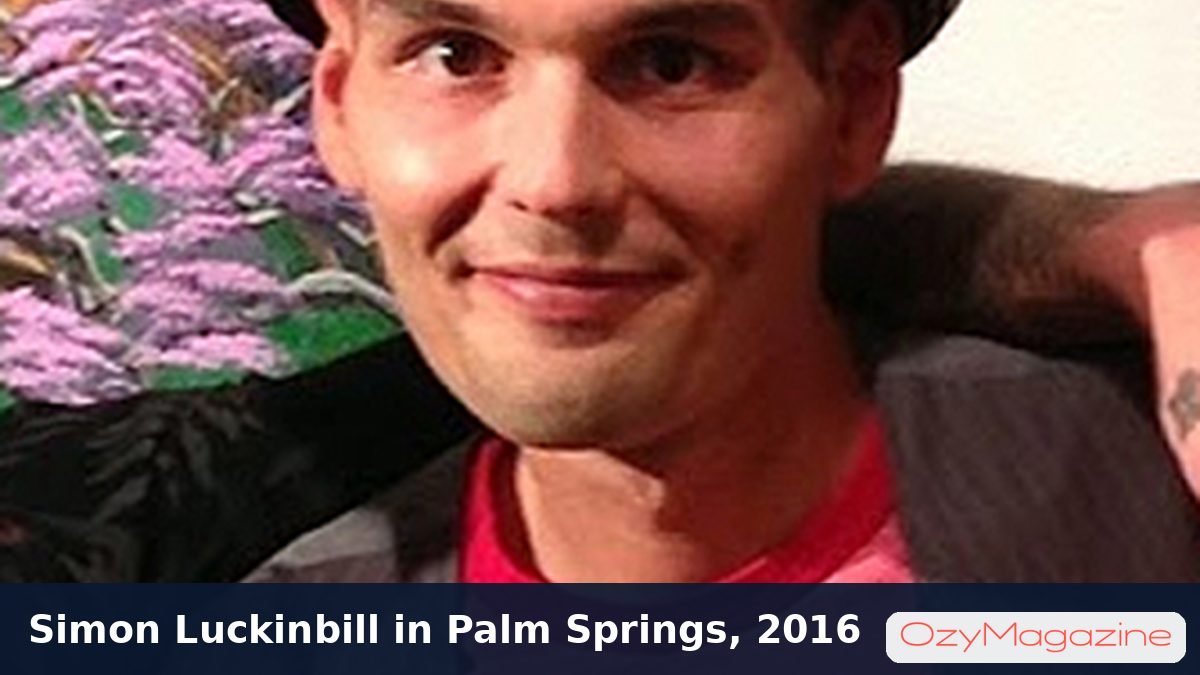
Coachella Valley Weekly marked it with “Simon Luckinbill Redux,” the long interview quoted throughout this profile, and noted his art page, Sy Art Gallery on Facebook, for readers wanting to see the work. Every original painting in the show, he told them, was exactly that: original.
The Hive Mind, singled out in that coverage, remains the best-described individual painting of his career: an exuberant, dreamlike canvas whose bamboo-grove subject surfaces only on a long look, a demonstration of the colour-and-texture method in a single work.
Why These Exhibitions Matter
Strip away the surname and the two shows still do real biographical work. They fix him, on dated and witnessed evidence, as an exhibiting artist with buyers — the difference between a famous person’s hobby and a practitioner’s career.
They also set the standard for judging later claims about him. A new exhibition, interview or gallery listing would extend the record in the same verifiable way; until one appears, the two Palm Springs shows are the career’s documented core.
Both shows, notably, were covered by local journalists who saw the work in person. That first-hand quality is what separates the exhibition record from the biography-site layer, where claims about Simon circulate without anyone having stood in front of a canvas.
Why Simon Luckinbill Chose a Different Career From His Famous Family
The interesting fact about Simon’s career is negative space: no sitcom, no stage debut, no attempt to convert the most bankable surname in television history into an acting career. Painting was not a fallback; it was a refusal of the obvious path.
Plenty of performers’ children test several arts before settling, and his sampling of music, poetry and nutrition fits that pattern. What sets the story apart is the destination — a solitary, object-making craft about as far from a studio audience as art gets.
Attention arrived before achievement could, as it does for anyone born into a famous family. The exhibitions answer that imbalance the only way available: with work that either holds a gallery wall or does not.
Simon Luckinbill’s Personal Life and Privacy
Measured against his relatives, Simon’s personal footprint is tiny, and the tininess is the story. He discusses paintings in public and himself almost never, so the standard celebrity file — partner, children, home, income — is missing precisely the pages readers look for.
The privacy is consistent across the whole record. There is no reality programme, no memoir, no controversy; the absence is not a gap in research but the shape of the life as he has chosen to present it.
Is Simon Luckinbill Married?
No dependable public source answers the question. No marriage announcement, interview or record of standing confirms a spouse, and nothing reliable confirms the opposite either, so the only honest entry is “not publicly documented.”
Biography sites that state his status flatly are guessing, and their guesses get copied as though a record existed. Limited information is not evidence of any particular circumstance, in either direction, and this profile declines to pretend otherwise.
The same discipline is applied throughout this article: where a fact about Simon cannot be traced to coverage, an interview or a documented family record, it is marked unconfirmed rather than repeated.
Does Simon Luckinbill Have Children?
The same answer applies. No reliable public reporting establishes whether Simon has children, and no statement from him or his family settles it. Any profile claiming named children, or claiming none, is going beyond the record.
Is Simon Active on Social Media?
His verified public footprint is an artist’s, not an influencer’s. The one presence documented by name is the art page Sy Art Gallery on Facebook, listed in the 2016 exhibition coverage as the place to view his paintings.
Beyond that, caution applies: accounts trading on his name are not confirmed as his, and readers should follow the documented art page rather than lookalikes. His parents, by contrast, have maintained the public profiles their long careers require.
Why Does He Avoid the Spotlight?
He has never explained the low profile in a widely documented statement, so motives are speculation. What can be said from evidence is that the pattern is deliberate and sustained: a decade of public record containing exhibitions and one art interview, and nothing else.
Plenty of people adjacent to fame choose exactly this. Being related to celebrated performers creates curiosity by default; feeding it is optional, and Simon’s record shows a man who declined the option while still showing his work.
Simon Luckinbill and the Meaning of a Creative Legacy
Legacy, for the third generation of a famous family, is usually discussed as an inheritance of opportunity. Simon’s case suggests a quieter version: what he inherited was fluency — a childhood in which making things was the family trade — and he spent it on canvas.
The other inheritance is temperamental rather than technical. His grandparents and parents built careers in collaborative, audience-facing forms; his work keeps the storytelling and drops the audience, trading applause for the slower verdict of a gallery wall. Our francie frane profile follows another member of a famous entertainment family who likewise built a public career on her own terms.
Read the two exhibitions and the 2016 interview together and a consistent figure emerges: an artist who took the family’s central skill, holding an audience’s feelings, and rebuilt it in the medium least like theirs. That, rather than the surname, is the creative legacy in action.
Simon Luckinbill’s Net Worth and Financial Information
Search engines pair his name with money constantly, and the honest answer is short: there is no disclosed figure. Simon has published no financial information, and no trustworthy reporting establishes what he owns, earns or has inherited.
Our sophie rain net worth profile works through the same problem from the other end of the fame scale: a fortune discussed everywhere and documented almost nowhere. Simon has exhibited original artwork and his paintings have reportedly attracted buyers, but knowing that an artist has sold paintings does not make it possible to calculate personal wealth. An accurate estimate would require information about factors such as:
- How many paintings he has sold across his career.
- What buyers paid for individual canvases.
- The commissions taken by galleries on each sale.
- What he spends on materials, framing and studio costs.
- His tax position and other professional expenses.
- Any income or obligations outside the art world.
Until some of those inputs exist in public, any number attached to his name is arithmetic performed on air. The documented facts support a narrower statement: he is a working artist who has sold paintings through Palm Springs galleries since 2014.
Interesting Facts About Simon Luckinbill
Here are several useful facts that help summarise his background and career:
Each of them can be traced to exhibition coverage, his published interview or his parents’ documented biographies. The list is shorter than the versions on biography sites because it leaves out everything that cannot be traced that way.
- The entertainment business is the family trade. He is the son of two working performers, Lucie Arnaz and Laurence Luckinbill.
- His grandparents helped invent the sitcom. Lucille Ball and Desi Arnaz, his mother’s parents, defined early television comedy.
- Los Angeles born, New York raised. Contemporary coverage places his birth in the first city and his childhood in the second.
- His birth month is reported as December 1980. The exact day has never been confirmed by a reliable source.
- He tried other arts first. Music, drumming, percussion, poetry and nutrition all came before painting in his studies.
- Painting won on colour and texture. His own account credits colour, texture and a hint of fantasy for holding his interest.
- His philosophy is on the record. The 2016 Coachella Valley Weekly interview preserves his views in his own words.
- His first opening sold quickly. A contemporary account said more than half his paintings sold within about 90 minutes in 2014.
- Both documented shows were in Palm Springs. Archangel Gallery hosted him in 2014 and Gallery 500 in 2016.
- Faith is among his stated inspirations. He named his Christian beliefs alongside music, nature and vision quests.
- He keeps a low public profile. Mainstream entertainment coverage of him personally is scarce next to his relatives’.
- No verified net worth exists for him. Figures printed online are estimates without records behind them.
Frequently Asked Questions About Simon Luckinbill
1. Who Is Simon Luckinbill?
Simon Luckinbill is an American painter and the son of actors Lucie Arnaz and Laurence Luckinbill. Rather than acting, he built a small, documented career exhibiting acrylic and mixed-media work in Palm Springs.
2. How Old Is Simon Luckinbill?
His birth is reported as December 1980. HELLO! magazine’s 2025 family roundup listed him as 44, which fits that month and year; no exact birth date has ever been reliably published.
3. Who Are Simon Luckinbill’s Parents?
Lucie Arnaz and Laurence Luckinbill, married on June 22, 1980. She is the actress and singer daughter of Lucille Ball; he is the Tony-nominated stage actor known for one-man plays and for playing Sybok in Star Trek V.
4. Is Simon Luckinbill Lucille Ball’s Grandson?
Yes — through his mother. Lucie Arnaz is Lucille Ball’s daughter, making Ball and Desi Arnaz Simon’s maternal grandparents, a connection documented in every account of the family.
5. What Does Simon Luckinbill Do for a Living?
He paints. His documented professional activity is visual art: acrylic and mixed-media canvases exhibited and sold through Palm Springs galleries, discussed at length in his 2016 interview with Coachella Valley Weekly.
6. Has Simon Luckinbill Exhibited His Artwork?
Yes, twice on the public record: Archangel Gallery in Palm Springs in March 2014, where a contemporary account reported most of the work selling on opening night, and Flea On A Hot Rock at Gallery 500 in December 2016.
7. Who Are Simon Luckinbill’s Siblings?
His full siblings are Joseph Luckinbill, a musician, and Katharine (Kate) Luckinbill. From his father’s first marriage he also has two older half-brothers, Nicholas and Benjamin Luckinbill.
8. Is Simon Luckinbill an Actor Like His Parents?
No acting career is documented for him. His public record contains painting, exhibitions and interviews about art only — a deliberate contrast with his parents and grandparents.
9. Is Simon Luckinbill Married?
Nobody knows from any reliable source. His marital status has not been confirmed in widely available public records or reporting, and claims either way should be treated as unverified.
10. What Is Simon Luckinbill’s Net Worth?
No verified figure exists. He has made no financial disclosure, and the estimates printed by biography websites rest on no records; his relatives’ estates are separate from his own finances and cannot be counted as his wealth.
11. Has Simon Luckinbill’s exact birth date ever been confirmed?
No. A specific December day circulates on biography websites, but none of them cites a record, an interview or a family statement, and no such confirmation exists. The month and year, December 1980, are as precise as the evidence gets.
12. Where can Simon Luckinbill’s paintings be seen?
His documented shows were in Palm Springs, at Archangel Gallery in 2014 and Gallery 500 in 2016. The 2016 coverage pointed readers to his art page, Sy Art Gallery on Facebook, for the work itself.
Conclusion
Taken on the evidence alone, Simon Luckinbill’s story is about a man handed the most famous surname in television and choosing the quietest available craft. The fame in the family is real; so are the two gallery shows, the sold canvases and the philosophy he stated on the record in 2016.
Where the evidence runs out — a birth day, a private life, a fortune — this profile has stopped with it. What remains is the part that can be shown: a painter whose work, not his ancestry, is the documented fact of his career.
That restraint is also a form of respect for the subject. Simon Luckinbill spent a decade keeping his life and his work separate in public; a biography that honours the work has no business inventing the life.
Final Thoughts on Simon Luckinbill
Simon Luckinbill matters to readers for two reasons that pull in opposite directions: the grandparents who changed television, and the grandson who wanted no part of the medium. Both are true, and the second is the more interesting story.
His mother’s parents built an empire on being watched. Simon built a modest career on being looked at — at his paintings, in a gallery, one viewer at a time — and the difference between those two kinds of attention is the whole biography in miniature.
For the full story of the grandmother whose fame frames his life, start with Lucille Ball and the career that made this family’s name; Simon’s own chapter is the one being painted, quietly, in Palm Springs.






One Comment