
Julianna Farrait: Frank Lucas’s Wife, Her Two Federal Cases and the Life Behind American Gangster
Julianna Farrait spent most of her adult life beside Frank Lucas, the Harlem heroin trafficker whose career became the film American Gangster. She shared the wealth of his empire years, and she carries a federal criminal record of her own.
That record is short, severe and unusually well documented. It holds a guilty plea after the January 1975 raid on the couple’s New Jersey home, and a five-year federal sentence imposed in Manhattan in February 2012, nearly four decades later.
Her story is often told as a footnote to her husband’s. The melissa linehan profile in this series covers another woman documented largely through family; Farrait’s file is different, because so much of it sits in court records and wire reporting rather than in profiles.
Quick Answer
Julianna Farrait is the Puerto Rican wife of Harlem drug trafficker Frank Lucas, played as Eva in American Gangster. She pleaded guilty after the 1975 Teaneck raid, and in February 2012 a Manhattan federal court gave her five years for a cocaine conspiracy in Puerto Rico.
Who Is Julianna Farrait?
Julianna Farrait is a Puerto Rican woman best known as the wife of Frank Lucas, who ran one of the largest heroin operations in New York in the late 1960s and early 1970s. Her married name was Julie Lucas, and court and wire reports use Julianna Farrait.
In the Celebrity coverage of the American Gangster story she is usually the supporting figure, the glamorous wife at the kingpin’s side. The documented record makes her something more specific: a twice-convicted federal narcotics offender in her own right.
That distinction matters. Farrait was not only present for her husband’s crimes. In 1975 she pleaded guilty in the case that destroyed his empire, and in 2010, long after that empire was gone, federal agents arrested her running a cocaine deal of her own.
Julianna Farrait’s Early Life and Puerto Rican Background
Julianna Farrait Biography at a Glance
| Detail | Information |
|---|---|
| Full name | Julianna Farrait (also written Julie Farrait; married name Julie Lucas) |
| Birth date | Not reliably published — no source of standing prints one |
| Birthplace | Puerto Rico |
| Nationality | Puerto Rican |
| Known for | Wife of drug trafficker Frank Lucas; her own federal cases in 1975 and 2010–12 |
| Husband | Frank Lucas (married 1967; died 30 May 2019) |
| Children | Daughter Francine Lucas-Sinclair; Lucas had seven children in all |
| Portrayed by | Lymari Nadal as Eva in American Gangster (2007) |
| Legal record | Guilty plea after the 1975 Teaneck raid; five-year federal sentence in 2012 |
| Net worth | Not reliably documented |
Two lines of that table carry her public story: the marriage that made her famous, and the legal record that is hers alone. Everything else in this profile hangs off those two threads.
One line deserves a word of its own. The birth line gives no date, because none exists in any reliable record — a point taken up in full in the dedicated section further down this profile.
Growing Up in Puerto Rico
Farrait was born and raised in Puerto Rico, and almost nothing reliable is published about her childhood there. No mainstream profile documents her parents, her schooling or her family’s circumstances, and she never gave the kind of interview that fills in those years.
What survives is her own brief account of leaving. In a 2008 interview with the Puerto Rican newspaper Primera Hora, quoted by NBC New York in 2010, she said she left Puerto Rico for New York in 1969.
That single sentence is nearly the whole documented record of her early life. Everything written elsewhere about her girlhood — pageants, schools, family businesses — comes without a source behind it, and none of it is printed here as fact.
Was Julianna Farrait Really a Beauty Queen?
Profiles of Farrait often describe her as a former beauty queen, and some call her a former Miss Puerto Rico. The claim travelled widely after American Gangster, whose Eva is presented as a past pageant winner from the island.
No pageant record supports it. No reliable source documents Farrait entering or winning Miss Puerto Rico or any comparable title, and the claim appears in print only where it is repeated without evidence.
The honest answer is that the beauty-queen story is part of the film’s mythology, not of her documented life. It says more about how the legend was packaged than about the woman herself.
★ Why This Profile Prints No Birth Date
Readers searching for Farrait’s age will find confident numbers attached to her name. They cannot all be true, and none of them comes from a record, so this profile prints no birth date, no birth year and no age for her.
The conflict sits in the best coverage she ever received. Reporting her May 2010 arrest, the Associated Press described her as 70 years old. The New York Post, covering the same arrest, put her at 63. Both numbers cannot hold.
Profile sites add further years of their own — 1940, 1941 and 1948 all circulate — each repeated from page to page without a citation. The francie frane profile on this site follows the same rule applied here: where reliable sources contradict each other, the contradiction is printed and the guesswork is left out.
How Did Julianna Farrait Meet Frank Lucas?
Their Initial Attraction
By Farrait’s own account, given to Primera Hora in 2008, she met Lucas at a nightclub after arriving in New York. It is the only first-person version of the meeting that exists in print, and it comes from her, not from his many retellings.
Lucas told his life story often and colourfully, and his versions of their meeting vary. Hers is a single plain sentence: she came to New York in 1969 and met him at a club. This profile prints her version as the documented one.
What followed is not in dispute. She joined the life of a man who was then building the heroin operation that would make him, for a few years, one of the most powerful traffickers in America.
When Did Julianna Farrait Marry Frank Lucas?
The marriage is widely reported as dating to 1967, and Lucas was still being described as her husband at his death in 2019. No marriage record has been published, but the 1967 date is the consistent point across decades of coverage.
The timeline sits awkwardly beside her own account of reaching New York in 1969, and no reliable source reconciles the two. Both are printed here as they stand in the record, with the tension between them left visible.
Whatever the exact year, the marriage lasted, on paper, for the rest of Lucas’s life. Whether the couple were ever formally divorced became its own small mystery, taken up in the marriage section below.
Frank Lucas: Understanding the Man Behind Julianna Farrait’s Fame
Frank Lucas was born in 1930 in La Grange, North Carolina, and raised in poverty in the Jim Crow South. He arrived in Harlem as a young man and worked his way up through the circle of the numbers operator and trafficker Ellsworth “Bumpy” Johnson.
After Johnson’s death in 1968, Lucas built his own operation. Its engine was supply: heroin bought in Southeast Asia’s Golden Triangle and moved to the United States through connections built around the Vietnam War, most importantly the former soldier Leslie “Ike” Atkinson.
The product, sold on Harlem streets as Blue Magic, was purer and cheaper than what rivals offered. For a few years the money was enormous, and Lucas later claimed earnings that prosecutors and historians alike have treated with caution.
The Rise of the Harlem Drug Empire
At its peak, the operation made Lucas one of the most visible rich men in Harlem. He bought property, dressed extravagantly and sat ringside at championship fights, all of it documented by the photographers of the era.
Visibility was the empire’s weakness as well as its advertisement. Lucas became a target for the federal investigators and New York detectives who would eventually bring the whole structure down, with his wife inside the house they raided.
His conviction in 1976 brought a seventy-year sentence. He cooperated with the authorities, the sentence collapsed, and he was released in 1981 — then arrested again in 1984 and imprisoned until 1991. He died on 30 May 2019, aged 88, in Cedar Grove, New Jersey.
Julianna Farrait and Frank Lucas’s Lavish Lifestyle
The Lifestyle Surrounding the Lucas Family
For roughly five years, from the late 1960s into the mid-1970s, the Lucas household lived at the top of Harlem’s illegal economy. The couple kept homes, cars and wardrobes that were meant to be seen, and they were seen.
The lifestyle is documented less in society pages than in court files and later reporting. What the government seized, and what witnesses described, sketches a household spending drug money at a pace that assumed it would never stop.
Farrait’s place in that household was public as well as private. She appeared beside Lucas at fights and clubs as the wife of the man of the moment, dressed for the role the money had bought.
Expensive Jewelry and Designer Fashion
The most famous single purchase of the era belongs to her. In Lucas’s own oft-told account, his wife bought him a chinchilla coat costing $125,000, with a matching hat at $40,000, for the first Ali–Frazier fight at Madison Square Garden in March 1971.
Lucas told the story himself, proudly, for the rest of his life. The coat’s point was display: a garment worth more than a house, worn to the most photographed sporting event of the decade.
The story has a sting he also acknowledged. The coat drew the eye of detective Richie Roberts, whose investigation would end the empire — display, in the end, was evidence.
Luxury Cars and Travel
The cars and the movement matched the clothes. Reporting on the empire years describes a family travelling between New York, New Jersey and Puerto Rico in the style the income allowed, with the Teaneck house as the suburban base.
None of it was held in a form that could survive attention. The wealth sat in cash, property and possessions, every one of them traceable once investigators began to look.
That is the practical truth under the glamour. The lifestyle was not separate from the business; it was the business, worn in public, and it left a paper and photographic trail a prosecutor could follow.
Why Their Wealth Was Ultimately Unsustainable
The fortune depended entirely on one supply line and one man’s freedom. When the January 1975 raid and the prosecution that followed removed Lucas, the income stopped and the assets became exhibits.
What the government did not seize, legal costs and time consumed. By the time Lucas cooperated his way to a shorter sentence, the empire’s money was a memory the family would chase, in one way or another, for decades.
Farrait’s later arrests cannot be understood without that collapse. The woman arrested in a Puerto Rican hotel room in 2010 had once watched more than half a million dollars in cash thrown out of her own bathroom window.
Julianna Farrait’s Role in Frank Lucas’s Criminal Activities
Did Julianna Farrait Know About the Drug Business?
No serious account suggests she did not. Farrait lived inside the household the business funded, appeared at its public celebrations, and, when the raid came, acted to move its cash out of the agents’ reach.
Her own words are scarce, but her documented actions are not ambiguous. A spouse who throws suitcases of money from a window during a federal raid is not a bystander, and the court that heard her plea did not treat her as one.
The harder question — whether she held any role in running the operation — is one the record does not answer. No reliable source documents her directing sales, supply or people, and this profile does not invent one for her.
From Association to Criminal Responsibility
The law drew its own line through her life twice. In 1975 her responsibility was folded into her husband’s case: she pleaded guilty in connection with the raid, as the New York Post recapped in 2010, and served a prison term reported at about five years.
In 2010 the responsibility was entirely her own. Lucas was by then an elderly man in poor health, long retired from the trade; the cocaine at the Isla Verde hotel was hers to sell, and the sentence that followed was hers to serve.
Between those two cases sits the episode her daughter witnessed in Las Vegas, told in the next section. Together they form the pattern of her record: three documented falls, each smaller than the last, across thirty-five years.
The 1975 Raid That Changed Julianna Farrait’s Life
Farrait’s Actions During the Raid
On 28 January 1975, a task force of DEA agents and New York police detectives raided the couple’s home in Teaneck, New Jersey. Inside, officers seized more than half a million dollars in cash, along with property deeds and safe-deposit keys.
Farrait’s part in that morning is the single most repeated fact of her life. As the New York Post recapped the case in 2010, she threw suitcases containing $585,000 out of a bathroom window as the agents came in.
The gesture failed, and it defined her. The cash was recovered, the house was lost, and her guilty plea in the case that followed made her a convicted participant in the empire’s fall rather than a witness to it.
The Collapse of the Family’s Wealth
The raid ended the rich years in a single morning. Lucas was arrested, the money was seized, and the prosecution that followed ended with his seventy-year sentence in 1976 and her own prison term.
Their daughter Francine, about three years old, was in the house that morning. Her later accounts describe a childhood reorganised by the raid: parents in prison, and long stretches raised by relatives in Puerto Rico.
What the family had owned was gone almost at once. The story of the Lucas fortune after January 1975 is a story of absence — of money remembered, talked about and, decades later, still being chased.
★ The Las Vegas Trip Her Daughter Never Forgot
The middle episode of Farrait’s record survives mainly through her daughter. In a detailed 2007 interview with Glamour, Francine Lucas-Sinclair described a childhood trip to Las Vegas that she had believed was a holiday with her mother.
It was not a holiday. As Francine told it, the trip was a drug exchange arranged for Lucas, by then released from prison and dealing again — and federal agents arrested her mother in their hotel room, in front of her.
Francine’s account puts her mother’s resulting prison term at about four and a half years, while Lucas drew seven years for that round of dealing, matching his 1984 conviction. This profile prints the episode as her daughter told it: a firsthand account, and the fullest description of Farrait as a mother that exists.
Julianna Farrait’s 2010 Arrest in Puerto Rico
What Happened During the Investigation?
Federal agents in New York had been monitoring Farrait through a government informant since February 2009, according to the criminal complaint in her case. The investigation ran for fifteen months before it surfaced.
The complaint describes a recorded conversation on 11 May 2010 in which she told the informant she had two kilograms of cocaine in Puerto Rico. She also pointed to a second person holding eight kilograms more.
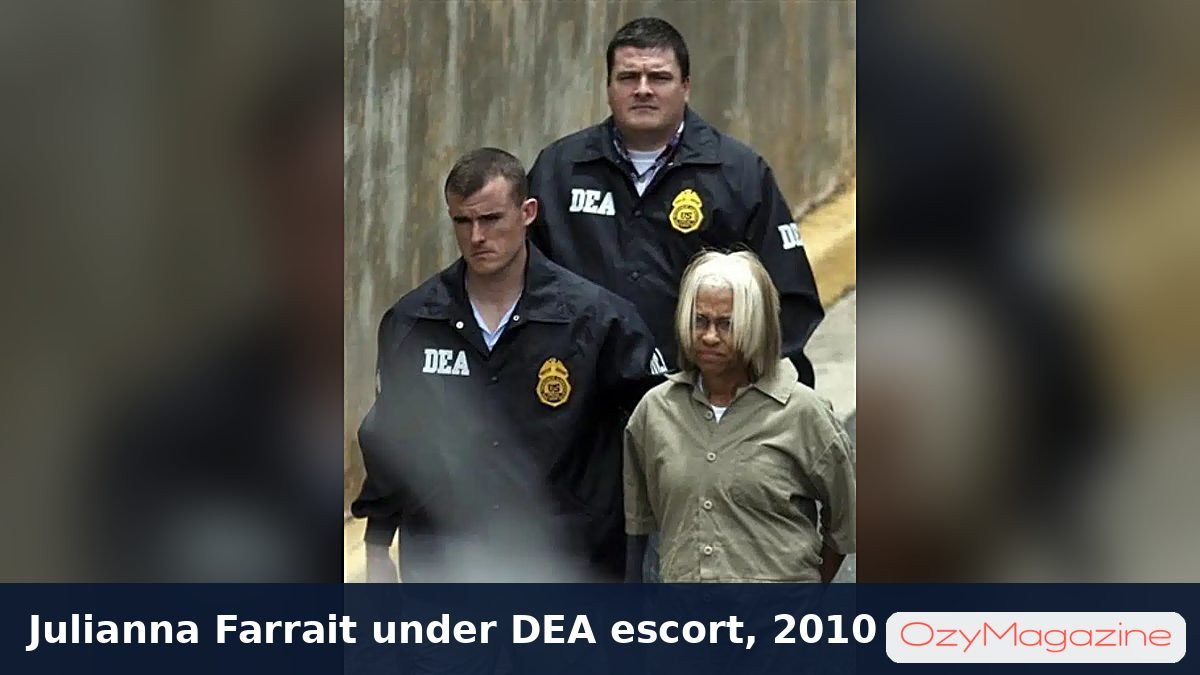
On 19 May 2010 she met the informant at a hotel in Isla Verde, the resort district east of San Juan, and presented the cocaine. DEA agents arrested her there, and wire photographers recorded her escort into federal custody the following day.
What Charges Did She Face?
The charge was filed from the Southern District of New York: conspiracy to possess and distribute five hundred grams or more of cocaine. The New York Post put a cash figure of $60,000 on the two-kilogram exchange.
At her first appearance in San Juan on 20 May 2010, a magistrate ordered her held without bail. She asked that the proceedings be conducted in Spanish, and at that stage she stood before the court with a public defender rather than a retained lawyer.
The DEA’s special agent in charge in New York, John P. Gilbride, summed up the arrest in one line that every report carried: “His wife has taken up his role.”
Julianna Farrait’s 2012 Prison Sentence
Farrait pleaded guilty to the conspiracy charge, and the case closed in a Manhattan federal courtroom at the end of February 2012. The judge imposed the mandatory five-year term, as the New York Post reported on 29 February 2012.
Sentencing coverage described her asking the court for mercy and compassion. She said she was ashamed to stand there at her age, and she asked for leniency so that she could care for Lucas, then 81 and in failing health.
The plea changed nothing in the arithmetic. Five years, mandatory, entered on the record — her second federal sentence, imposed thirty-seven years after the raid that produced the first.
Julianna Farrait and Frank Lucas: Marriage, Separation, and Reconciliation
Why Did They Separate?
The marriage’s separations were imposed from outside. Prison divided the couple for most of the years between 1975 and 1991: his seventy-year sentence, her terms, his second conviction, and the long stretches when one or both of them were inside.
Geography divided them too. She spent periods in Puerto Rico, where she had been raised and where their daughter was partly brought up; he remained tied to New York and New Jersey, the ground of his reputation.
Even their legal status blurred in print. Covering the 2010 arrest, the Associated Press called her Lucas’s wife, while the New York Post captioned her his ex-wife — and no public record of a formal divorce has ever been produced.
Loyalty and Personal Attachment
What the record does show, across five decades, is return. After the empire, after prison, after his second conviction and long decline, Farrait was still beside Lucas at the end of his life, and still asking a court in 2012 for the chance to care for him.
Her 2008 Primera Hora interview, given when the film had made them famous again, presented the marriage as a bond that had survived everything the courts had done to it. Nothing in the later record contradicts her.
Lucas died on 30 May 2019. The marriage that began in the 1960s ended only there, whatever the captions of 2010 had called it — and she was photographed at his funeral, as the section on the funeral photograph below describes.

Julianna Farrait’s Children and the Impact on Her Family
Francine Lucas-Sinclair’s Childhood
Francine Lucas-Sinclair is the publicly documented daughter of Farrait and Lucas. Lucas had seven children in all; Francine is the child of the marriage whose own account of the family has been published and quoted for two decades.
She was about three years old when agents raided the Teaneck house in January 1975. Her childhood, by her own telling, was then divided between imprisoned parents, relatives in Puerto Rico and, for a period, the federal witness protection programme while her father cooperated.
She was still a child when she watched agents arrest her mother in the Las Vegas hotel room. No other member of the family has described what those years cost as directly as she has.
The Creation of Yellow Brick Roads
Francine turned that childhood into advocacy. She founded Yellow Brick Roads, an initiative providing support and resources to children whose parents are in prison — the situation she had lived through twice before she was grown.
The work gave the family story a second public chapter that belonged to neither parent. Where Farrait avoided attention for most of her life, her daughter chose to speak, in interviews and through the initiative, about what parental imprisonment does to a child.
Her 2007 Glamour interview remains the most detailed firsthand account of Farrait that exists. Most of what is reliably known about Farrait as a mother comes from her daughter’s testimony, not from Farrait herself.
Why Her Daughter’s Experience Matters
Francine’s account corrects the glamour at the centre of the Lucas legend. In her telling, the famous wealth reads as a brief, frightening prelude to raids, courtrooms, prison visits and a childhood spent waiting for parents to come home.
It also explains the silences elsewhere in this profile. Farrait gave almost no interviews and left almost no public words; the family’s memory was carried, instead, by the child who had watched it happen.
Any honest profile of Julianna Farrait runs through her daughter. The court records give the offences and the sentences; Francine gives the cost.
Julianna Farrait in American Gangster: Fact vs. Fiction
How Accurately Was Farrait Portrayed?
Ridley Scott’s American Gangster reached cinemas in 2007, with Denzel Washington as Lucas and the Puerto Rican actress Lymari Nadal as his wife, Eva. The Associated Press and NBC New York both identified Eva as the character drawn from Farrait.
Nadal’s Eva is younger, quieter and more ornamental than the documented woman. She is shown enjoying the wealth and pleading with her husband to leave the life, but the film gives her no crime of her own — no window, no suitcases, no plea.
The portrayal is therefore accurate as atmosphere and misleading as biography. The real Farrait’s defining public acts were criminal ones, committed at the beginning and at the end of the story the film tells.
Important Differences Between the Movie and Reality
The film’s Eva arrives with a pageant past, presented as a former Miss Puerto Rico. As the beauty-queen section above sets out, no record supports that title for Farrait; it is an invention that flatters the legend.
The film also ends its marriage story in the 1970s. Reality ran for another forty years: a second arrest in Las Vegas, a separation measured in prison terms, a 2010 cocaine case and a sentencing at which she begged to be allowed to nurse her husband.
Even the wealth is simplified. The film treats the fortune as a fact of the couple’s life; the record shows it collapsing in a single morning in 1975 and never returning.
Why the Film Should Not Be Treated as a Documentary
American Gangster was built from Lucas’s own telling of his life, and Lucas was a gifted self-mythologiser. Historians and former investigators disputed parts of his account even as the film turned it into the accepted version.
For Farrait the distortion is sharper, because she never told a competing version. She gave one brief interview in 2008 and otherwise let the film’s Eva stand where her own voice might have been.
The documented record — court files, wire reports, her daughter’s testimony — is less romantic and more interesting. It is the record this profile follows.
What Happened to Julianna Farrait After Prison?
Life Away From Public Attention
The February 2012 sentencing is the last dated entry in Farrait’s verified public record. No reliable report documents her release date, her residence afterwards, or any public appearance she made on the record after that courtroom.
That silence is consistent with the rest of her life. Outside her arrests, Farrait never sought publicity: no memoir, no talk shows, no interviews beyond the single 2008 conversation with Primera Hora.
What can be said is structural rather than personal. A five-year federal sentence imposed in 2012 would ordinarily have run its course in the middle of that decade, with any release a matter of prison records rather than press coverage — and none has been published.
Did Julianna Farrait Die Before Frank Lucas?
Reports circulating online state that Farrait died in 2017, two years before her husband. The claim is repeated across profile sites, but no mainstream obituary, death notice or named source has ever been produced for it.
Set against it is photographic evidence from 2019, examined in the section that follows: a dated funeral photograph identifying her beside her stepson at Lucas’s own funeral in June of that year.
The honest position is that her death has been reported but never verified, while her presence in 2019 has photographic support. This profile prints neither a death date nor a claim that she is living today; the record supports neither.

★ The 2019 Funeral Photograph
Frank Lucas died on 30 May 2019, and his funeral was held in Newark, New Jersey, on 11 June 2019. A photograph from that day, credited to Johnny Nunez and carried by Getty Images, identifies Julianna Farrait among the mourners, walking beside Frank Lucas Jr.
Her appearance in the frame is plain: an elderly woman in a black cardigan over a floral blouse, her greying hair pulled back, supported by her stepson’s arm. Her face matches, feature by feature, the woman in the 2010 arrest photographs, aged by the nine years between them.
The photograph matters because it is evidence, in a story short of it. If the woman in the frame is Farrait — and the caption, the company and the face all say she is — then the reports of a 2017 death are wrong, and she outlived the husband she had asked a court to let her nurse.
Julianna Farrait’s Net Worth and Financial Reality
Was Julianna Farrait Wealthy?
Once, briefly and illegally, yes. At the start of the 1970s Farrait shared a household funded by one of the largest heroin operations in America, and the cash seized in a single raid on that household exceeded half a million dollars.
That wealth was never hers in any durable form. It was spent as it arrived, held in cash and possessions, and confiscated or consumed when the prosecution came; nothing in the record shows assets surviving into her later life.
By 2012 the financial picture in the courtroom was the opposite of the legend. The woman asking for mercy was not a rich widow guarding a fortune, and no reporting from her cases describes money of any consequence.
Why Online Net Worth Estimates Are Unreliable
Profile sites attach figures to Farrait’s name anyway, in the usual round numbers. None of them cites a document, a filing, an interview or an estimate by anyone who has seen her finances, because no such source exists.
Her case shows why the genre fails, a point the tesehki net worth profile also makes from a very different career: where no earnings, assets or statements are documented, a printed figure is a guess wearing a number’s clothes.
This profile therefore prints no net worth figure for Julianna Farrait. The documented financial facts are the ones above: extraordinary illegal income for a few years, total collapse in 1975, and no verified wealth at any point afterwards.
The Broader Lessons From Julianna Farrait’s Life
1. Wealth Does Not Guarantee Security
The Lucas fortune bought five loud years and nothing durable. When the raid came, the money was evidence, the property was seized and the family’s security vanished with the income that had created it.
2. Personal Relationships Can Influence Major Life Decisions
Farrait’s documented choices track her marriage at every turn: the window in 1975, the Las Vegas exchange run for her husband, and, in her own stated reason in 2012, a wish to care for him in his decline.
3. Children Experience Consequences They Did Not Create
Francine Lucas-Sinclair committed no offence and served the longest sentence of anyone in the family: a childhood organised around prisons. Her later advocacy exists because those consequences were real and, for years, uncounted.
4. Hollywood Fame Can Distort Historical Understanding
For most of the world, Farrait is Eva — a pageant winner in a beautiful dress. The documented woman pleaded guilty twice, served two federal sentences and died to public view in a Manhattan courtroom in 2012. The film is the reason for the interest; it is not the record.
5. People Should Be Understood Beyond a Single Relationship
Farrait is filed under her husband’s name in almost everything written about her. Her own record — the plea, the Las Vegas trip, the Isla Verde hotel room — is a separate story of choices that were hers, and it deserves to be read as one.
Julianna Farrait Timeline: Major Events in Her Life
| Year | Event |
|---|---|
| 1967 | Marriage to Frank Lucas, as widely reported |
| 1969 | Leaves Puerto Rico for New York, by her own account; meets Lucas at a nightclub |
| 1971 | The chinchilla coat at the first Ali–Frazier fight, in Lucas’s own telling |
| 28 January 1975 | Federal raid on the couple’s Teaneck, New Jersey home; she throws suitcases of cash from a window |
| 1976 | Lucas sentenced to seventy years; Farrait serves a prison term after her guilty plea |
| 1980s | Las Vegas arrest described by her daughter; a term of about four and a half years follows |
| 2007 | American Gangster released; Lymari Nadal plays Eva, the character drawn from Farrait |
| 2008 | Her Primera Hora interview, the fullest account she ever gave |
| February 2009 | Federal agents begin monitoring her through an informant |
| 19 May 2010 | Arrested at a hotel in Isla Verde, Puerto Rico, over two kilograms of cocaine |
| February 2012 | Five-year federal sentence imposed in Manhattan |
| 30 May 2019 | Frank Lucas dies in Cedar Grove, New Jersey |
| 11 June 2019 | Photographed at Lucas’s funeral in Newark |
The timeline’s shape is the biography in miniature: a crowded six years at the start, then decades in which almost everything that is documented about her happens in a courtroom.
One absence in it is deliberate. There is no birth year at its head, because — as the dedicated section above explains — no reliable source has ever published one.
Frequently Asked Questions About Julianna Farrait
1. Who was Julianna Farrait, and why is she famous?
Julianna Farrait is the Puerto Rican wife of Frank Lucas, the Harlem heroin trafficker whose life became American Gangster. She is famous through that marriage and through her own federal cases: a guilty plea after the 1975 raid and a five-year sentence in 2012.
2. Did Julianna Farrait go to prison?
Yes, more than once. She served a prison term after pleading guilty in the 1975 case, a term of about four and a half years followed the Las Vegas arrest her daughter describes, and a Manhattan court imposed five years in February 2012.
3. Who played Julianna Farrait in American Gangster?
Lymari Nadal, a Puerto Rican actress, played Eva, the wife character the Associated Press and NBC New York identified as drawn from Farrait. Denzel Washington played Frank Lucas in Ridley Scott’s 2007 film.
4. How many children did Julianna Farrait and Frank Lucas have?
Their publicly documented child together is their daughter, Francine Lucas-Sinclair, who founded Yellow Brick Roads for children of incarcerated parents. Lucas had seven children in all, and Frank Lucas Jr. appears beside Farrait in the 2019 funeral photograph.
5. Is Julianna Farrait still alive, and where is she now?
Nobody can say from the public record. Online reports claim she died in 2017, but no mainstream obituary supports them, and a dated photograph places her at her husband’s funeral in June 2019. Nothing reliable has been published about her since.
Conclusion: The Real Legacy of Julianna Farrait
Julianna Farrait’s legacy is a double exposure. In one image she is Eva, motionless in a beautiful dress beside a movie kingpin; in the other she is a defendant, twice over, in federal courtrooms thirty-seven years apart.
The second image is the documented one, and it is the more human story: loyalty and crime bound together in one marriage, wealth that evaporated in a morning, and a daughter who turned the wreckage into work for other people’s children.
What she leaves behind is not a fortune or a legend of her own making. It is a record — two court cases, one interview, one funeral photograph — that corrects the film every time it is read carefully.
Final Thoughts on Julianna Farrait
Farrait never wrote her version of the story, and the gaps in this profile are the shape of that silence. Where the record runs out — her birth date, her childhood, her life after 2012 — this profile has said so rather than fill the space with invention.
For the career that made her a footnote in other people’s searches, the Frank Lucas biography sets out his record in full. Hers ends differently: a wife who outlasted the empire, the prisons and, on the photographic evidence, her husband himself.





2 Comments