
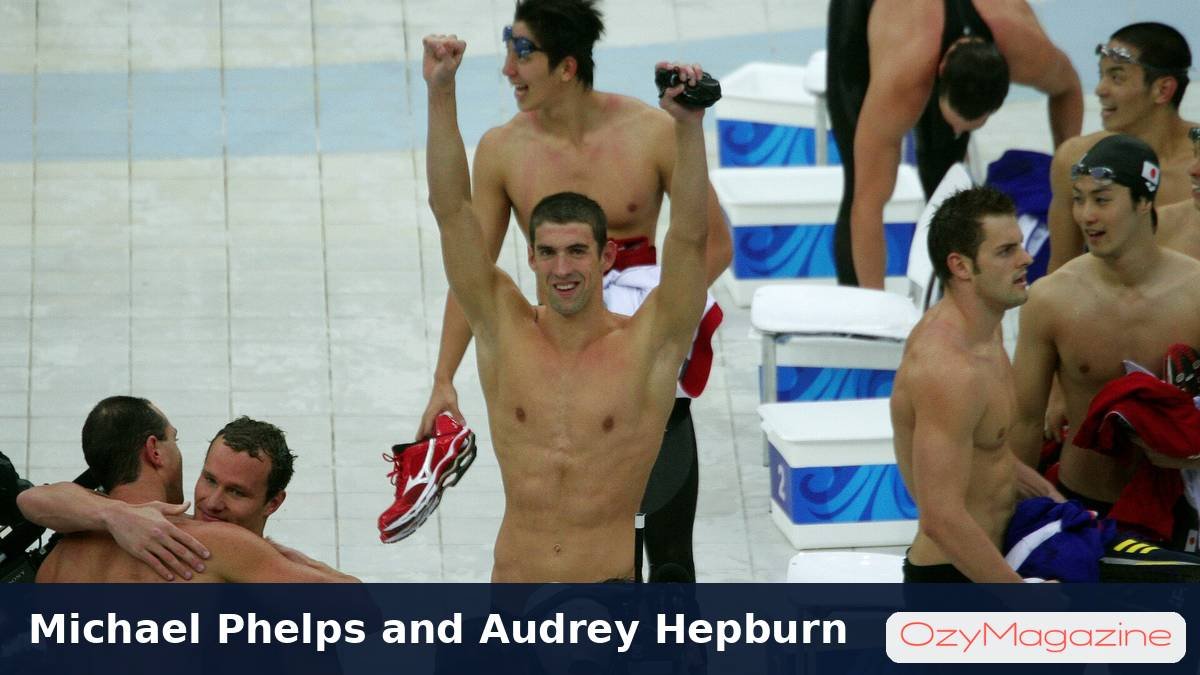
Michael Phelps and Audrey Hepburn: Two Legends, Compared
Type michael phelps and audrey hepburn into a search engine and the two names arrive as a pair, even though one belonged to Hollywood’s golden age and the other to the Olympic pool. Readers keep asking whether they were related, whether they met, and what connects them.
The short answer is that nothing connects them personally. Our previous profile, of sophie rain net worth, covered a fortune built online in three years; this pairing is the opposite case, two twentieth-century-scale reputations built decades apart.
What follows gives each of them a full hearing: Hepburn’s road from wartime Arnhem to UNICEF’s front line, Phelps’s road from a Baltimore pool to 28 Olympic medals, and then an honest comparison of what the two records actually share.
Quick Answer
Audrey Hepburn (born 4 May 1929, died 20 January 1993) was a British film icon who became a UNICEF Goodwill Ambassador; Michael Phelps (born 30 June 1985) is the most decorated Olympian in history, with 28 medals. They were not related, never met, and are paired online purely as a comparison of two record-setting lives.
Michael Phelps and Audrey Hepburn at a Glance
Two careers, two centuries of fame between them, and not a single day of overlap at their peaks. The headline facts sit side by side here; the detail follows below.
| Detail | Audrey Hepburn | Michael Phelps |
|---|---|---|
| Full name | Audrey Kathleen Hepburn (born Ruston) | Michael Fred Phelps II |
| Born | 4 May 1929, Ixelles, Brussels, Belgium | 30 June 1985, Baltimore, Maryland, USA |
| Died | 20 January 1993, Tolochenaz, Switzerland, aged 63 | Still living, aged 41 |
| Nationality | British | American |
| Field | Film, then humanitarian work | Competitive swimming |
| Signature honour | Academy Award for Roman Holiday | 28 Olympic medals, 23 of them gold |
| Defining record | One of very few EGOT winners | Most decorated Olympian of all time |
| Second act | UNICEF Goodwill Ambassador | Mental-health advocacy and his foundation |
| Family | Two sons, Sean and Luca | Wife Nicole Johnson, four sons |
| Net worth | Died in 1993; no modern estimate applies | Estimated at $100 million by Celebrity Net Worth |
Who Were Audrey Hepburn and Michael Phelps?
Audrey Hepburn was a British actress who became the defining female face of classic Hollywood. Films such as Roman Holiday and Breakfast at Tiffany’s made her a star, and her later work for UNICEF made her something rarer: a celebrity whose second career outshone the first.
Michael Phelps is an American former competitive swimmer, now 41, whose 28 Olympic medals make him the most decorated Olympian in history. Across five Games he turned one sport’s record book into a personal ledger, then retired in 2016 to a second life in advocacy.
Set side by side in our Celebrity coverage, the pairing looks odd until the pattern shows: each reached a summit nobody else has matched, then spent the fame on a cause. That pattern, not any personal link, is why the names travel together.
Audrey Hepburn and Michael Phelps Quick Bio Table
The quick-reference version first, in the order the searches usually ask it: her dates, his dates, and the one-line summary of each life.
| Detail | Audrey Hepburn | Michael Phelps |
|---|---|---|
| Birth name | Audrey Kathleen Ruston | Michael Fred Phelps II |
| Birthplace | Ixelles, Brussels, Belgium | Baltimore, Maryland, USA |
| Grew up in | Belgium, England and the Netherlands | Rodgers Forge, Towson, Maryland |
| First training | Ballet, in Arnhem and London | Swimming, from the age of seven |
| Breakthrough | Roman Holiday (1953) | World record at 15, in 2001 |
| Career span | 1948–1993 | 2000–2016 |
| Best known for | Holly Golightly and the UNICEF years | Eight gold medals at Beijing 2008 |
| Cause after fame | UNICEF field missions | Mental-health advocacy |
| Story ends | Died 1993, aged 63 | Retired 2016, aged 31 |
Audrey Hepburn: Early Life and Background
Audrey Kathleen Ruston was born on 4 May 1929 in Ixelles, Brussels, to a Dutch baroness, Ella van Heemstra, and a British businessman, Joseph Ruston. Her childhood moved between Belgium, England and the Netherlands before her parents’ marriage collapsed and her father walked out, an event she later called the most traumatic of her life.
War fixed her in Arnhem. She trained at the Arnhem Conservatory under the name Edda van Heemstra, danced in closed-door performances that raised money for the resistance, and lived through the famine winter of 1944–45, when her family ground tulip bulbs into flour.
Malnutrition left her with anaemia and a fragile constitution, and it followed her to London. Ballet Rambert’s verdict was kind but final: talent, yes, but her height and health would never carry her to prima ballerina. So she acted instead.
How Did Audrey Hepburn Become Famous?
Small film parts and stage work came first, including a Broadway run in Gigi, but the leap arrived in a single summer. Cast opposite Gregory Peck in Roman Holiday (1953), she played a runaway princess with a lightness Hollywood had not seen, and won the Academy Award for Best Actress.
She remains the first actress to win an Oscar, a Golden Globe and a BAFTA for the same performance, and she added a Tony Award for Ondine in the same twelve months. Sabrina, Funny Face, The Nun’s Story and Breakfast at Tiffany’s followed, each one enlarging the legend rather than repeating it.
By the late 1960s she was choosing family over film sets, working only occasionally. More screen legends from her era and his sit in our TV & Film section, but none matched her trick of becoming more famous after the films stopped.
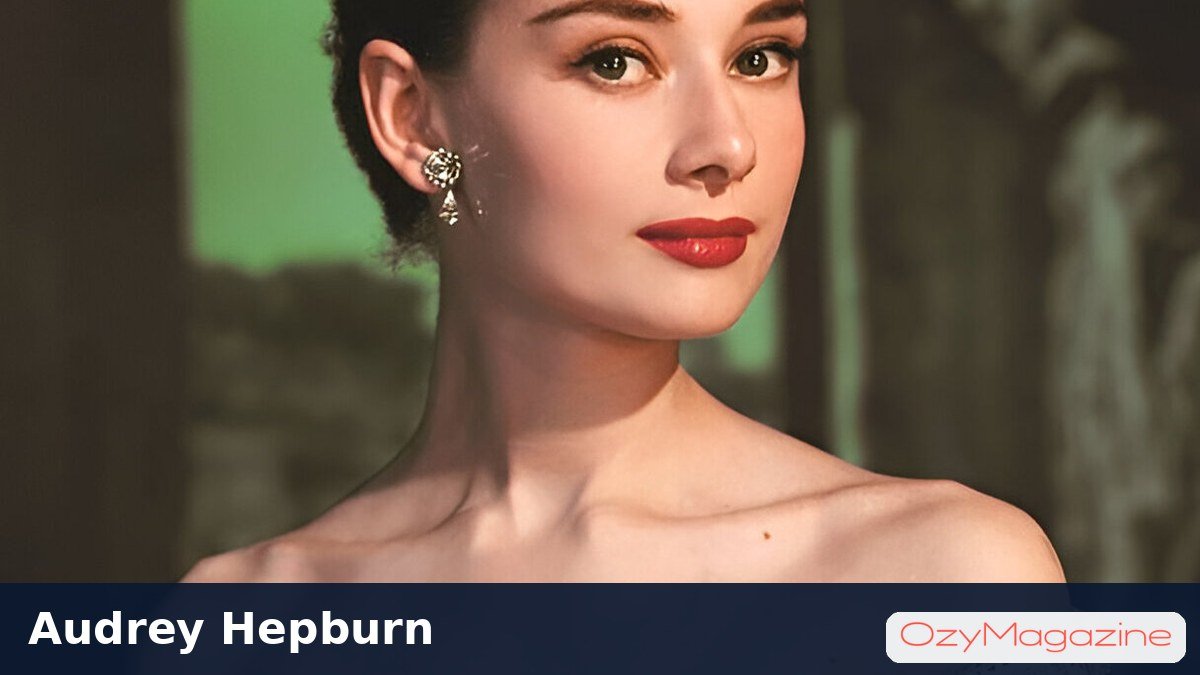
Audrey Hepburn’s Family and Personal Life
Hepburn married the actor Mel Ferrer in Switzerland in September 1954, and their son Sean was born in 1960. The marriage lasted fourteen years. In January 1969 she married the Italian psychiatrist Andrea Dotti; their son Luca arrived the following year, and that marriage ended in 1982.
From 1980 she shared her life with the Dutch actor Robert Wolders, whom she described as her husband in everything but paperwork. She called the years with him the happiest of her life, and he stayed beside her until her death.
Home, from 1960 onward, was La Paisible, a farmhouse in Tolochenaz, Switzerland, chosen for privacy and quiet. She cooked, gardened, raised her sons largely away from cameras, and treated the film industry as a place she visited rather than lived.
Audrey Hepburn’s Style Legacy: The Givenchy Years
Fashion made Hepburn immortal in a way film alone could not. Her partnership with the young couturier Hubert de Givenchy began on Sabrina in 1954, when she travelled to Paris to choose her character’s wardrobe in person, and it lasted, personally and professionally, for the rest of her life.
Givenchy dressed her in Love in the Afternoon, Funny Face, Breakfast at Tiffany’s and Charade, building the silhouette the world still copies: slim trousers, ballet flats, monochrome dresses, nothing spare. The black dress from Tiffany’s became one of the most recognisable costumes ever put on film.
Her influence was democratic in a way couture rarely is. The look asked for posture and simplicity rather than money, which is why Vogue could call her the acme of classic beauty and why high-street shops still sell her outline every season.
What Did Audrey Hepburn Do for UNICEF?
Hepburn’s connection to UNICEF began in the 1950s, narrating radio programmes for the organisation, but it deepened into a vocation after her first field mission to Ethiopia in 1988. She was appointed a Goodwill Ambassador in 1989, and she explained the debt plainly: she had been a hungry child who received international aid herself.
The missions were working trips, not photo calls:
- Ethiopia, 1988: an orphanage at Mek’ele holding 500 starving children
- Turkey, 1988: a nationwide immunisation campaign completed in ten days
- Sudan, 1989: Operation Lifeline, ferrying food into a civil war
- Bangladesh, 1989: field visits she made famous for simply hugging children
- Vietnam, 1990: immunisation and clean-water programmes with the government
- Somalia, 1992: famine relief she described with one word, “apocalyptic”
She testified before the United States Congress, addressed the press in several languages, and kept travelling as her health failed. In December 1992, weeks after Somalia, President George H. W. Bush presented her with the Presidential Medal of Freedom; the Academy added its Jean Hersholt Humanitarian Award after her death.
How Did Audrey Hepburn Die?
Hepburn returned from Somalia in late September 1992 with abdominal pain. Tests in Switzerland were inconclusive, so she travelled to Los Angeles, where doctors at Cedars-Sinai found a rare abdominal cancer, pseudomyxoma peritonei, spread in a thin coating across her small intestine.
Too weak for a commercial flight after surgery, she was flown home to Geneva on a private jet arranged through Givenchy, and she spent her last Christmas at La Paisible. She died in her sleep there on 20 January 1993, aged 63, and was buried in the village cemetery at Tolochenaz.
Michael Phelps: Early Life and Background
Michael Fred Phelps II was born on 30 June 1985 in Baltimore, Maryland, and raised in Rodgers Forge, a neighbourhood of Towson. His mother Debbie, a school principal, and his father Fred, a Maryland state trooper, divorced when he was nine; his two older sisters, Whitney and Hilary, were already competitive swimmers.
Phelps started swimming at seven, partly in imitation of his sisters and partly to drain a surplus of energy. Diagnosed with ADHD in the sixth grade, he found in the pool the one environment where focus came naturally, and by ten he held a national age-group record in the butterfly.
At eleven he came under coach Bob Bowman of the North Baltimore Aquatic Club, the man who would direct his entire career. At fifteen he qualified for the Sydney 2000 Olympics, the youngest American male swimmer to make the team in 68 years, and finished fifth in his only event.
How Did Michael Phelps Become the Greatest Olympian Ever?
The foundation was a world record at fifteen years and nine months, in March 2001, which made him the youngest male swimmer ever to hold one. Athens 2004 turned promise into haul: six gold medals and two bronze, eight medals at a single Games, matching a record set in 1980.
Beijing 2008 is the summit the sport still measures itself against. Phelps won all eight of his events, breaking Mark Spitz’s record of seven golds at one Olympics, and took the 100-metre butterfly by a single hundredth of a second, a finish officials checked frame by frame.
London 2012 carried his career total to 22 medals, beyond any athlete in history, and after a retirement and a comeback he closed at Rio 2016 with five more golds and a silver. Twenty-eight medals, 23 of them gold: the arithmetic is the argument.
Michael Phelps by the Numbers
Strip away the commentary and the career is a column of figures no other athlete has approached. He set 39 world records, more than any swimmer in history, and won 82 medals across the Olympics, World Championships and Pan Pacific Championships, 65 of them gold.
| Games | Gold | Silver | Bronze | Total |
|---|---|---|---|---|
| Sydney 2000 | 0 | 0 | 0 | 0 |
| Athens 2004 | 6 | 0 | 2 | 8 |
| Beijing 2008 | 8 | 0 | 0 | 8 |
| London 2012 | 4 | 2 | 0 | 6 |
| Rio 2016 | 5 | 1 | 0 | 6 |
| Career total | 23 | 3 | 2 | 28 |
Sydney’s zero matters to the shape of the story: he arrived at fifteen, left without a medal, and then medalled at four straight Games. Sports Illustrated named him Sportsman of the Year for 2008, and his peers chose him to carry the American flag into the Rio opening ceremony.
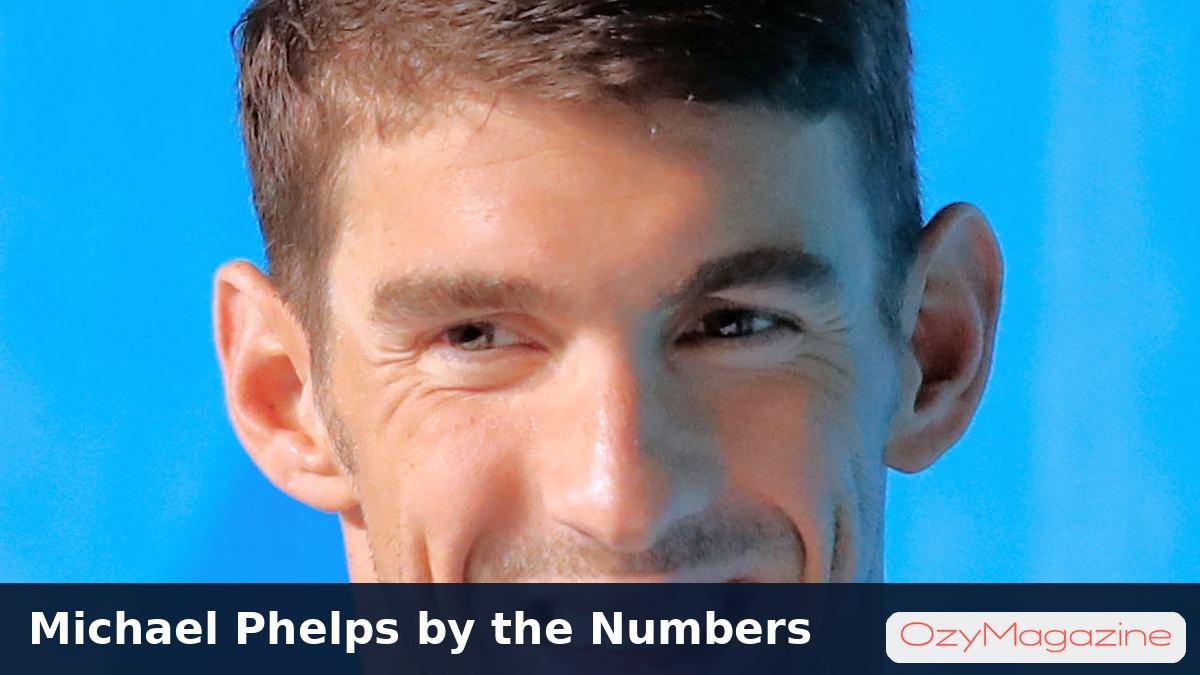
Michael Phelps’s Family Life
Phelps married Nicole Johnson, a former Miss California USA, in a ceremony so quiet it stayed secret for four months. They had met at the ESPY Awards in 2007, separated and reconciled more than once, and became engaged in February 2015 before marrying on 13 June 2016.
Their first son, Boomer, was born in May 2016, weeks before the Rio Games, and three more sons followed. The family lives in Paradise Valley, Arizona, where Phelps has volunteered as an assistant swim coach at Arizona State, the programme Bowman now leads.
The family frame matters to his story because he tells it that way. His parents’ divorce marked his childhood, his father’s death in 2022 drew a public tribute, and fatherhood is the role he now puts first in interviews.
Why Is Michael Phelps a Mental Health Advocate?
In January 2018, Phelps told the public what the medals had hidden: he had lived with depression and anxiety for years, and after the London 2012 Olympics he had contemplated suicide. The most decorated athlete alive was describing, on the record, how close the story came to ending early.
He converted the disclosure into work. He joined the board of a mental-health diagnostics company, lent his name and face to campaigns urging people to try therapy, and accepted the Morton E. Ruderman Award in 2019 for advocacy on behalf of people with disabilities and mental-health conditions.
His foundation, funded in 2008 with his $1 million Speedo bonus, runs the same philosophy at child height: its “im” programme teaches swimming, water safety and goal-setting through Boys & Girls Clubs. The message in both registers is identical, that asking for help is a strength and not a surrender.
How Much Is Michael Phelps Worth?
Celebrity Net Worth estimates Michael Phelps’s fortune at $100 million, and published estimates generally cluster in a band from about $80 million to $120 million. No official statement confirms any figure, and ours reports the estimate as exactly that: an estimate, attached to its source.
The money was never mainly prize money, because swimming pays its champions modestly. It came from endorsements and sponsorships across two decades, from swimwear and watches to food brands, plus the business ventures and speaking work that followed retirement. More fortunes, checked the same way, sit in our Net Worth coverage.
Set against Hepburn, the comparison is lopsided by era: she died in 1993, before celebrity wealth was tracked this way, and no credible modern estimate of her estate exists. One fortune can be estimated; the other belongs to a different economic age of fame.
Are Audrey Hepburn and Michael Phelps Related or Did They Ever Meet?
No to both, and the dates make the second answer unavoidable. Hepburn died on 20 January 1993; Phelps, born in June 1985, was seven years old, a Baltimore schoolboy who had just started swimming. There is no photograph, letter, event or mutual acquaintance linking them.
They share no family line either. Her roots were Dutch and British aristocracy; his are Maryland working stock, a teacher and a state trooper. The pairing exists because search engines group famous names, and because readers enjoy measuring one kind of greatness against another.
Audrey Hepburn and Michael Phelps: What Do They Actually Have in Common?
The honest overlap is structural, not personal. Each conquered a field that produces thousands of hopefuls a year and very few immortals, and each then treated fame as a resource to be spent on strangers rather than a cushion to retire onto.
Shared qualities
- A record that still stands alone: her EGOT and AFI ranking, his 28 medals
- A second career in service: UNICEF missions for her, mental-health advocacy for him
- A childhood marked by hardship: wartime famine for her, ADHD and divorce for him
- An image the public still rents: her silhouette sells fashion, his name sells resilience
Beyond that, the similarities stop, and pretending otherwise would flatten two genuinely different lives into a slogan.
Audrey Hepburn vs. Michael Phelps: Achievements, Legacy, and Influence Compared
Hepburn’s legacy is cultural and compounding: the films stay in circulation, the style is reissued every season, and the UNICEF template she set, the working ambassador rather than the ceremonial one, is now the job description. The American Film Institute ranks her third among the female screen legends of Hollywood’s golden age.
Phelps’s legacy is statistical and, so far, untouchable: nobody else owns 23 Olympic gold medals, and the gap to the next swimmer is measured in careers, not medals. Layered over the numbers is a newer legacy, as the athlete who made it permissible for elite sportsmen to discuss depression in public.
| Measure | Audrey Hepburn | Michael Phelps |
|---|---|---|
| Field | Cinema | Olympic swimming |
| Peak years | 1953–1967 | 2004–2016 |
| Crowning honour | Oscar, Emmy, Grammy and Tony | 23 Olympic gold medals |
| Record that stands | AFI’s third-greatest female screen legend | Most decorated Olympian ever |
| Cause after fame | UNICEF field missions | Mental-health advocacy |
| Personal link | None; she died in 1993 | None; he was seven in 1993 |
Two Eras of Fame: Studio Hollywood and the Social Media Olympics
Hepburn’s fame was manufactured by studios and rationed by them: a handful of films, controlled photographs, interviews granted sparingly. Scarcity protected the mystique, and because she withdrew to Switzerland, the public image froze at its most elegant, which is one reason it has never dated.
Phelps’s fame ran the other way, in real time and in public: televised races, sponsorship feeds, a photograph of a bong that cost him sponsors in 2009, and eventually his own disclosure of depression, delivered on his own channels. Nothing stayed frozen; the audience watched him age, err and recover.
The contrast explains why the pairing fascinates. She is fame as a finished portrait; he is fame as a livestream. Both, unusually, ended up respected more for what they did after the peak than during it.
Frequently Asked Questions
Are Audrey Hepburn and Michael Phelps related?
No. There is no family connection of any kind. Hepburn was born in Brussels in 1929 to Dutch and British parents; Phelps was born in Baltimore in 1985, fifty-six years later, to a teacher and a state trooper.
Did Audrey Hepburn and Michael Phelps ever meet?
No meeting is documented, and the calendar rules one out in practice. Hepburn died in January 1993, when Phelps was seven years old and had only just started swimming in Maryland.
Why are Audrey Hepburn and Michael Phelps mentioned together?
Because readers compare them. Search engines pair globally famous names from different fields, and this pairing offers a clean contrast: cinema’s most graceful star against sport’s most decorated athlete, each with a humanitarian second act.
What connects Audrey Hepburn and Michael Phelps?
A pattern rather than a relationship. Both reached a level in their field that nobody else has matched, and both converted that fame into sustained work for causes: children in crisis for her, mental health for him.
What was Audrey Hepburn most famous for?
For Roman Holiday, which won her the Academy Award, and Breakfast at Tiffany’s, whose Holly Golightly fixed her image permanently. Her UNICEF ambassadorship, from 1989 until her death, runs a close second in the public memory.
How many Olympic medals did Michael Phelps win?
Twenty-eight: 23 gold, three silver and two bronze, won across the Athens, Beijing, London and Rio Games. It is the largest medal total of any Olympian in history, and his 23 golds are also a record.
What did Audrey Hepburn do for UNICEF?
She served as a Goodwill Ambassador from 1989, travelling on field missions to Ethiopia, Sudan, Bangladesh, Vietnam and Somalia, testifying before Congress and fundraising worldwide. She received the Presidential Medal of Freedom for the work in December 1992.
Why is Michael Phelps known for mental health advocacy?
Because in 2018 he disclosed publicly that he had battled depression and anxiety and had contemplated suicide after the 2012 Olympics. He has since campaigned for therapy and openness, particularly among athletes, and built the message into his foundation’s work.
What is the main difference between Audrey Hepburn and Michael Phelps?
Their fields and their eras. Hepburn’s fame was built by the studio system and preserved by withdrawal; Phelps’s was built by live television and tested in public. She is remembered for grace under scarcity, he for endurance under exposure.
Final Takeaway
Audrey Hepburn and Michael Phelps never met, share no blood and worked in different centuries of fame. What the pairing actually offers is a study in two kinds of summit: hers, an artistic one guarded by privacy, and his, an athletic one conducted entirely in the open.
Both then did the same unusual thing with the summit. She spent it in famine zones on UNICEF missions; he spends it telling young athletes that depression is treatable and help is strength. The records explain the fame; the second acts explain the respect.
For the full record behind the swimmer’s half of this pairing, his encyclopedia entry at Wikipedia’s Michael Phelps profile is the deepest single source, and it is the fitting place to end.



One Comment